Thursday, February 10, 2011

Jodhpur


After Jaisalmer we took a train to Jodhpur. We left Jaisalmer late in the afternoon and it took a few hours to get to Jodhpur so by the time we arrived it was after dark. Experience will tell you that it’s better to arrive in a new town during the day time. Night can be disorientating. We were supposed to be greeted by someone from the hotel, as Chimmy had done for us in Jaisalmer, but when we got off of the train there was no one there. As we made our way past the rickshaw drivers and said, “No, no thank you” about 20 times one driver asked, “where are you going?”. When we told him the Cosy Guests House he said, “Are you Kevin?” and when I answer yes he immediately called someone and said my name several times. I assume he called our hostel to tell them we arrived, so we found our driver. However, when he pointed to a rickshaw and we got in a different guy jumped in the driver seat and we immediately had to begin negotiations for price all over again. We then zoomed down dark alleys taking hairpin turns at great speed and with no concern for oncoming traffic. More than once we missed head on collision by just seconds. This is very much India.
Finally the driver stopped, pointed to a sign painted on the side of a building that had the name of our hostel and pointed up the road, which was too narrow for his rickshaw. We ambled out, wary as ever of our driver, but what could we do besides trust the dilapidated painted sign and go up the dark narrow alley in this unfamiliar city?
At the hostel we were greeted with what I can only describe as slight surprise and small embarrassment. It appears that the front desk person was not expecting us and had only one room available, not the one we reserved. I wonder who in the world the first driver was talking to if it wasn’t the front desk.
Again, what choice did we have? So we agreed to stay in that room until the next day and so spent the night at the Cosy Guest House. I will admit that it was actually pretty nice and cozy, especially for 6 dollars a night. From the rooftop restaurant we had an awesome view of the fort. As it turned out the next day we only did a couple of things like going to the local bazaar, which we saw a lot of as we circled in about a dozen times trying to find a bookstore that Lonely Planet Recommended, but that no one had heard of and which turned out to be closed for the day. It was interesting seeing the same people over and over again tempting us with the same lines, “bracelet, 10 for 100, now you buy” or “you come in my shop, come see my shop, you come in, come”. In a way it was like riding some sort of infuriating ride like ‘Its a Small World’ where the same characters sing the same thing over and over again until you feel like it really is a small world and maybe you really do want to buy 10 bracelets for 100 rupees and then you snap out of it and realize that you don’t even know 10 people, let alone 10 who would be willing to wear those bracelets.

Later in the afternoon we got going to the fort. Although going to the fort was really the only constructive thing we did it completely made the day.
After winding up hill for about 20 minutes we reached the front gates of the Mehrangarh fort. Built on a high rock outcrop with walls 40 meters high and 6 meters thick it looked very solid. Before entering the gate I got a guided tour headset, the kind you push numbers into as you see numbered displays marked along displays and then you hear an explanation of what the room or object is. Mine was grand; the guide’s voice was that of a man who was clearly Indian, but had an English accent much like I imagine the narrator of the Jungle Story would have. I felt like I was getting a history straight from a colonial subject. He was a man with a neat beard and a turban, a bit on in age, someone who was well educated and whimsical as well as fatherly in his guidance. As you can tell I immediately formulated an image in my mind of what this man looked like and the gestures he used. This pleased me greatly.
As we made our way into the fort we had to pass a number of gates, 7 in all, each becoming smaller and harder to get through than the last. The most interesting I thought was the last, the Loha Pol, which you get to by going up a long ramp which abruptly turns on a right angle just before the gate’s doors which are very heavy with large spikes on them. I thought surely that the spikes were unnecessary, but was quickly corrected by my guide as I punched in number 12. He told me that this was designed to detour elephants from ramming the gate first because it was difficult to get speed if you have to turn at a right angle like that right before the gate and second the long spikes coming from the door which even an elephant won’t do well with. Just by the gate are the red hand prints of widows whose husbands died in battle and who themselves committed suicide by immolating themselves on their husbands’ funeral pyres. Now that is dedication.
Inside are a number of more elaborate palace rooms which are now filled variously with things such as human carriers, elephant carrier baskets, an armory, clothing, and religious artifacts. Some of these were quite interesting and again my headset gave me the grand tour. I learned a lot about the kings who had resided there, the last of whom was still alive and living nearby. I also learned about princesses, wars, decadence, and religious practices. It was all very nice. At the end of my guided tour Aya and I went out onto the rampart and looked at the various cannons and the awesome view of the ‘Blue City’. It is named as such because the locals have painted many of their houses in the color of indigo which was readily available years ago and also works as an insect repellent as well as lending a cool air to the buildings in the heat of Rajasthan. (yes, from the headset)
The tour guide had told me that on the ramparts were the cannons of various countries as when the army had defeated an enemy they took a cannon as a prize of war. One of these cannons was supposedly from China when the local army joined the British in fighting in the Opium Wars. We looked and looked, but never found the cannon. We did see a few other countries, but no indication of a Chinese one.
Unfortunately we only had one full day in Jodhpur and the next day we were on our way early, moving on to Jaipur and a little bit closer to Delhi and a little bit closer to flying to Kathmandu. Most unfortunate of all was that I had to turn in my headset and say goodbye to my guide. I wish his voice would have accompanied me on my entire trip.

Tuesday, February 08, 2011

Jaisalmer


After flying into Delhi on the night of the 21st and staying in one of the worst hotels I have ever been in, we got our train from Delhi to Jaisalmer. This however, was not without trouble as when approaching the New Delhi train station we were approached by what we thought was a rail worker and told a story that almost resulted in us being scammed. More on that later, I intend to do a whole post about the scams we encountered.
After finally finding our train at Old Delhi station we boarded and got ready for the overnight ride. We rode in AC two tier, which basically means the car is cooled and in each berth there are four beds which fold down. It was actually not too bad for sleeping and I was none the worse after 9 hours of overnight travel. As we approached Jaisalmer in the late morning I started to have a headache and to feel a bit like diarrhea was coming on. As we got off the train I knew I was in for something. Luckily we found our hotel manager Chimmy waiting for us at the station and within 20 minutes we were being shown our rooms at the Hotel Suraj. Just after settling in I headed for the bathroom which inaugurated a 12 hour session of losing fluids in all ways possible. Luckily Aya was still feeling ok and with the help of Chimmy was able to locate some medication, water, and soft foods. By late in the evening my stomach was starting to un-cramp and I could keep some fruit and water down, by which time Aya was also feeling ill. It was a terrible night, but by morning light we were both feeling a bit better and managed to get up the strength to go next door for breakfast at sunrise before going back to bed for another 4 hours or so. By noon we were feeling good enough to make a little circuit around the castle, but not much more that day, just a lot of resting and restocking fluids. It is amazing how frail the human body is.
On our final day in Jaisalmer we made it to Gadsisar Lake on the southern edge of town and to some other havelis outside of the fort. Unfortunately we didn't get to take the overnight camel ride into the desert that we were hoping for, but we were really glad to be back on our feet and had a good laugh about the quality time we spent together.

Jaisalmer's Hotel Suraj


I'm sure this sounds a bit like a brochure, but I really wanted to describe this hotel because I found it so interesting.
This is a bit of the view of the Hotel Suraj, where we stayed in Jaisalmer. The hotel itself is in a very old Haveli(stone carved house)that has been owned by the same family for generations. To get to the hotel you have to enter the fort, past ramparts and gates, and then weave your way among narrow lanes, filled with merchants and the errant cow, to get to the hotel. On the first floor the owner's family lives. In the center of the building is an open courtyard that goes to the sky and lets in light during the day. To the south side of the building is a stairwell that leads to the roof on the 5th floor if I remember. We had a room on the 3rd floor which had open windows to the courtyard and to the west.
Going into the room are a pair of ancient, heavy wooden doors that can only be locked by chain at the foot of the door. The room has the air of a cave, but not too dark or dank, open and refreshingly cool in the heat of Jaisalmer. In the ceiling are a number of hooks that have been drilled into the rock, obviously long ago. These were used for oil lanterns to light the room. Colorful paintings adorned the walls. Being located in the fort itself made for a very convenient way to see Jaisalmer's main attraction. The family who owns the place is also friendly and the manager, Chimmy, was very helpful in getting us anything we needed, which turned out very well.

Monday, February 07, 2011

20/30


Entering into my thirtieth year (note, I turned 29 years old on January 30th so I have 29 behind me, hence entering the 30th) I also entered into my 20th country outside the U.S., Nepal.No longer a teen. More on that later.
As I think back on the travels I have done and the cultures that I have seen I am happy with the choice I have made to forgo the alternatives. Travel can take up time and resources that could have been used for something else which of course then the question comes to mind, 'what could I have done with this time/money?'. This is especially true when you have a trip that was not entirely enjoyable. Even in these times there are lessons to be learned. I believe that learning those lessons are very valuable. I think given the alternative my time and money is well spent. I intend to continue my travels, which you will see here, and to continue exploring the world. I hope you all will stay here with me and enjoy the ride. Cheers.

Sunday, January 09, 2011

Throw Away Society


Last week in teaching economics I used a new article from the Washington Post about Amazon as an example of a company or individual patenting a new technology. If you didn’t hear about it, Amazon has come up with a way to return gifts you receive before you even receive them. If you are feeling cheated already, wait until you hear more.

With this new technology you can set up various filters which will essentially guarantee that you get gifts you want and don’t get gifts you don’t. For example; your mother sends you a CD for Kenny G for Christmas, via Amazon. You hate Kenny G, so months ago you set up your account to say, “any gift involving Kenny G convert to gift card” and BAM! You get a gift card instead of the Kenny G CD. Now the tricky part, does mom find out? Well, you have the option, you can send a card saying, “thanks for the Kenny G” or you can say, “Thanks for the Kenny G, but I converted it to a gift card, I don’t like Kenny G.” You can also set your account to convert all gifts from mom, no matter what. Or you could set it up to interact with a wish list so no matter what the gift or from whom you convert it.
The reason a retailer like Amazon would do this is to cut production costs. Every time someone doesn’t get the gift they want a package comes back to the warehouse and has to be repackaged and restocked, not to mention the initial un-stocking and shipping that was wasted to begin with. Amazon is cutting costs, raising profits. When 28 billion in goods was sold this holiday season and 30% of those returned I can hear the Amazon share holders clinking glasses now.

The reason I found out about this new technology was because of a discussion that was happening in my office near my desk. Where I work 4 teachers share a large room and so we chat often exchanging ideas. I got involved in a conversation about what a big waste Christmas gifts are. The idea that pretty much all of us were agreeing to was that Christmas has gotten too commercial. The massive amount of goods that people buy and the carelessness with which they do it is, well, not good.

Now some of you may remember 4 years ago when I wrote a post here called “Gift of the Magi” You may find it here

Mainly I lamented the waste of Americans and suggested that Christmas was about something deeper than gifts. I stand by that. I also said a few things about the amount of trash that Americans are expected to generate during their lifetimes. Combining waste on the consumer and well as producer end it would be about 1,000 tons of garbage. A very small percentage of that gets recycled, but a lot of it just goes to a landfill. In landfills many things can break down, or decompose. Unfortunately not everything can decompose. Most plastics do not decompose. Ever. They can get smaller and smaller, but they never break down. This is a problem considering the proliferation of plastics and the ever growing human population.

3 years ago I read a book called ‘The World Without Us’. While the first half was terribly interesting and detailed how everything we have built up as humans would just fall apart if we were to disappear, the second half of the book was almost exclusively about plastic. It was at this time that I first learned about the Great Pacific Garbage Patch.
The patch is an area in the Pacific Ocean, floating thousands of miles from civilization, somewhere between the size of Texas and the continental United States. It is hard to say because no one can draw a distinct boundary around plastics floating in the oceans. The best you can do is to measure concentrations of plastic in the water. Estimates by the UN are that in the garbage patch there are 40,000 pieces of plastic per square mile. The Patch is characterized by exceptionally high concentrations of plastics, chemical sludge, and other debris that have been trapped by the currents of the North Pacific Gyre, one of five such gyres in the world. The North Pacific Gyre works in the way a toilet would, swirling slowly and concentrating matter in the center. Because of this, much garbage in the ocean will find its way into the center of the gyre, though it may take years. During that time much of the plastic is broken into smaller bits and sinks below the surface, but is still in the water. Note though breaking into smaller bits doesn’t mean that it turns into its base elements. That will never happen. It is just that the plastic becomes smaller pieces of plastic.
Essentially people may think, this garbage patch is floating in the ocean, very far from land. That is gross, but it isn’t actually harming us and even if it were, it is a patch and we could just clean it up. Like most problems in the world people think that if it’s not in front of them they don’t care enough to do anything about it.

The problem actually is right in front of us. Plastic comes back to us in many ways. Animals living in the oceans, fish most obviously but also other organisms, eat those pieces of plastic because they resemble food. In some parts of the gyre concentrations of plastic are 10 times the amount of biomass. When creatures seek small organisms like plankton for food they are really getting a lot of plastic. While eating plastic is bad enough these pieces of plastic are extra toxic. Due to the nature of plastics they are a magnet for toxic materials and as this plastic floats through the ocean it accumulates toxins from the water around it. By the time an animal eats the plastic it can have up to a million times the toxicity of the water surrounding it. When you plug that into the equation you may want to think twice about eating marine life. As the plastic works its way up the food chain the toxicity becomes greater and greater, just like large fish like tuna and marlin are known to have high levels of mercury the larger a fish gets the higher the concentration of other things as well. The next time tuna or other ocean fish land on your plate remember that you are just another step up the food chain, accumulating what your food has accumulated.
So of course, we should clean it up, but the reality is that we can’t. The project is too huge. No government, let alone even a combination of governments, would be willing to spend the resources projected to clean up the ocean.
There is no easy solution to the garbage patch. What will likely happen is that human consumption of plastic will continue, the patch will grow, and marine life will increasingly suffer, meaning we will too. The best thing that we can do is to use our power as consumers of plastic to change the types of plastic we consume and the level at which we consume them. Before buying that Halloween mask you will use once, before taking that plastic bag at the grocery store, before buying a product from the shelf that has lots of unnecessary packaging, before choosing which kind of bottled drinks think for just a second about how you can make a better choice.
It has been more than a year now since I became vegetarian and I don’t regret it at all. In fact it has been one of the best decisions I have ever made, one that I am most proud of. Sure, I do occasionally think it would be nice to have a burger or maybe some cured ham, but now I know what my consumption habits result in and I can’t justify eating meat anymore. Faced with that choice, denial or changing my lifestyle, I changed my lifestyle. I saw something wrong with the world and instead of ignoring it because it seemingly wasn’t right in front of me; I took the time to understand it better and to take responsibility for my actions. I plan to do the same thing this year with plastic. Sure, it will be impossible to get away from plastic. It is everywhere. However, I can greatly reduce the amount and type that I use. Reducing the amount can be done in easy ways like bringing my own re-usable grocery bag to the store. Aya and I have done this for about 2 years now and it is working great. I estimate we use about 300 less plastic bags every year, but really that is a drop in the ocean, we can do much better.
Changing the type of plastic I use may be much harder, but I have some leads on how to do so. There are more than a handful of companies now that are investing in non-petroleum base, biodegradable plastics. Earth Soul and Plantic are two examples of companies making plastic from biodegradable materials and Sony has developed a plastic that it now uses in its product, which is biodegradable. In the United States Cargill has developed a plastic made from chicken feathers. Two birds with one stone there, taking a waste product and making into a new product.
It will take time and much more research to figure out exactly in what ways I can change my habits. We are all in different situations and one person’s abilities are not the same as another’s but we can all take a few minutes to consider the world around us. Now that you have read this you too can be faced with a decision, denial or change of lifestyle?

http://www.earthsoulindia.com/
http://www.sciencedaily.com/releases/2005/03/050325184643.htm
http://www.plantic.com.au/docs/Plantic_Media_Release_Sainsbury.pdf
http://www.sony.net/SonyInfo/technology/technology/theme/vegetableplastic_01.html


Saturday, December 04, 2010

And 59 To Go


Just over a month ago Aya arrived in Shanghai. I brought a photo with just to make sure it was her (pictured). As usual I was surprised by how small she is. More than that I was so accustomed to a silent house that having my little chatter box back has changed my world here. She has changed my world in many other ways too. It has been a year now since we were married in Hawaii and in some regards that seems like only yesterday. To celebrate one year together we took a trip to Hangzhou. It’s a scenic town not far from Shanghai. I expected a smaller town with nice scenery since it had been hyped up that way by people I had talked to and the research I had done. There were supposed to be some nice hiking and running trails surrounding that a scenic lake. I was very much looking forward to that as Shanghai is a busy place with lots of people, thick air, and few places that are quiet and people free.
We departed Shanghai on a bullet train which zipped through the country side at 350kmph. The train ride was nice enough, but as I looked out the window I kept thinking, “Ok, we are getting further into the country side, when are we going to get to a place where the smog parts and the blue sky shows itself?” I kept reassuring myself that Hangzhou and blue skies were just around the corner. I was sorely disappointed.

Hangzhou has some nice scenery, but like every other place I have been to in China it was packed with people and very polluted. As we arrived at the train station and hailed a taxi it was obvious that this place was not a smaller city. Sky scrapers could be seen nearby through a haze of smog. The train station was brimming with people coming and going from Hangzhou. I was immediately crestfallen as I realized this was not going to be a weekend where I got away from the city atmosphere.

Indeed, there were mountains and scenic pagodas. There were nice views and old structures. There were hiking trails and running trails that wound through nice patches of mountain side and scenic lakeside landscaping. It had all the potential for a nice place to be for a weekend. At one point after climbing a pagoda we spent some quiet time in a tea garden, the tea was really good, and for a moment we escaped the city. We walked about a lot and saw some sights, but the first feeling of being in a smoggy crowded place was prevalent. We made the best of it and enjoyed our time just being together and relaxing. At one point we had wandered down a side street and the strangest feeling fell over us. It took us a few minutes to realize what it was; we weren’t surrounded by people, traffic, smog, and noise. It felt great.

Since then I have had none of that silence, back here in Shanghai. There has been no silence outside and none inside either. Aya has been waiting for me when I come home each day as we continue our lives here. I enjoy my job immensely and she says she enjoys her life here too learning Chinese and tending house. There are certainly things that we don’t like, but it seems that we have found enough things we do like to keep us here a bit longer. I think part of that is just having each other. Three months without her was too much and I could tell that my stress level was higher before she was here. While I still value my private time I am growing more and more appreciative of having a partner to share my life with, someone to unburden my concerns to, share a laugh with, to be perfectly honest, to share in my triumphs and my defeats no matter how mundane. Our futures are now tied together and each step we take is together.
Recently one of my dear friends passed away. I have followed some of his widow’s thoughts as she tries to make sense of such a sudden change of her life and the impact it has had is one that is obvious. Once you have committed your life to one person and built towards the future together, what happens when one day they disappear? I try to never think about it, yet think of it all the time. I wonder what Aya would do if I suddenly died. While it pains me to picture her as a widow it pains me even more to know that I won’t be there anymore. In my own selfish way I think the worst part of my death won’t be that I can no longer experience the world, but that I will no longer have the company of my wife. On our trip I remarked to Aya that we had, “One year down...” To which she replied, “…and 59 to go". I hope that is true.
.

Sunday, October 10, 2010

Expo


369,300; that is how many people went to the World Expo 2010 in Shanghai on the same day I did which seems like a lot until compared to the Expo’s peak day, the 15th of June, which saw 518,000 people attend.
The exhibition, which opened on 1st May and runs until the end of October, has been seen as Shanghai's chance to showcase itself to the rest of the world. In spending a reported $46 billion spent on the Expo, China has invested more money in it than the 2008 Beijing Olympics. Official figures have predicted 70 million visitors will flock to the 240 pavilions and exhibitions staged by participating countries and organizations, spread out over 2.5 miles of Shanghai's Huangpu riverbank. So far 58,386,600 visitors have visited the Shanghai expo. While most come from China itself some, like me (technically), are overseas visitors.
I had gone to the expo briefly with Aya in June when we were here for a couple of days, but because of time constraints we only went in for a couple of hours and saw just two pavilions. I only remember one, Israel, which I thought was rather disappointing. The building itself looked very cool from the outside, but the main portion of the inside was dedicated to a movie showing the advancements in technology Israel has made and connections with China. In my eyes both subjects were forced and not very interesting.

This time around I went alone. I intended to spend a whole day, but arrived a bit late around 10am and then left a bit early at 4pm because me feet were starting to hurt and lines were getting monstrously long. This time around I went to 5 pavilions, the African Shared Pavilion, the South American shared Pavilion, the Cuban pavilion, the USA pavilion, and the New Zealand pavilion.
The Cuban pavilion was terribly depressing and the only thing I remember from it is that there was a man selling bottles of rum, or some kind of liquor. There wasn’t even a line, just two open doors leading in and out of the pavilion. I guess you can’t have a line if there is nothing to wait for. The African shared pavilion and the South American shared pavilion had some interesting points, but also some very shabbily put together areas. At some times I imagined that a class of 6th graders had been put to task setting up displays. The New Zealand pavilion was neat. There was a giant green stone in front for visitors to touch, nice displays of NZ life and overall a cool design. The USA pavilion was by far my favorite, which feels boastful for me to say because I took pride in what the USA pavilion focused on in contrast to what other pavilions focused on. In every other pavilion I saw the focus was on physical achievements like mining, exports, advancements in technology, or the unique regions of a country. All those are fine things to be proud of and showcase, but America’s pavilion focused on something intangible.

Yes, I can barely believe it myself, American’s did not focused on the goods they make, the land they have, or the advancements in technology. Rather they were focused on ideas. Yes, ideas. As the pavilion’s site says, “The Pavilion presents the U.S. as a place of opportunity and diversity where people come together to change their communities for the better.” There were three films in three different rooms of the pavilion as a group of a couple hundred people we were moved from room to room. The first film had an array of ordinary and not so ordinary Americans, including Kobe Bryant, Tony Hawk, and Michelle Kwan, attempting to speak to visitors in Chinese(for the record Kwan has no trouble speaking Chinese). The takes are not perfect and visitors get to see the many mistakes that people make trying to say something in Chinese. It was great. It set the audience in a playful mood and got everyone smiling. Next visitors are led to see a second film featuring the likes of U.S. President Barack Obama and Secretary of State Hillary Clinton. Here they and a group of children talk about the innovative ideas that Americans will come up with in the future. Kind of a ‘Promise of Tomorrow’ type film. The third film features a story on urban landscapes with moving seats for thunder and a sprinkling of water for rain when those parts come up in the narrative.
At the end of the second film the audience cheered! Can you believe that? Cheered! I never saw anything like that at the other pavilions. No one cheered the guy selling rum in Cuba. The Green stone of New Zealand was cool, but no one laughed. Pointing out the connection between Israelis and Chinese was nice, but didn’t get any applause.

I could feel the emotion from the films and the emotion from the audience around me and I could see, for the first time here, the way that some Chinese people look at the United States. Outside waiting in line I met a young girl who I talked to for the 30 minutes or so it took for us to get through the line. She told me about her family, her upbringing and her desire to study in the U.S. Inside the pavilion I met two young men who were anxious to speak to me about what I thought of the US pavilion. Listening to them I was put into the perfect mindset for what I was about to see.

The Expo’s slogan is ‘Better City, Better Life’ and I have to imagine that if the estimated 70,000,000 visitors come to Shanghai in the course of 6 months that indeed the city will become better. The government will be forced to clean up, for at least 6 months, and the economic activity visitors bring with them will improve the city of Shanghai. No matter what happens, I can take away a little peace of mind. A reminder to myself that even with all the wealth of land and achievements that America has the potential of America's future might be more valuable than all of that.

Sunday, August 15, 2010

The Red Button


The red button is located just inside the door of my new apartment. The first time I saw it I was with the guy who was inspecting my apartment. He was running around, flipping switches and opening doors just to make sure everything was working ok. I saw the button as we entered the apartment and was waiting to see when he would flip it, but as it turns out he didn't. Later that day as I was moving in furniture I again paused to look at the red button. What could it possibly do? There was no clear indication and so I thought it best to just let it be. For the next couple of days I would look at that button on my way in and out of the apartment and wonder what it was for. Finally, one morning, I decided to push it. Bracing myself I gave it a quick sharp jab. I stood stock still for a moment listening to for any detectable sound and watching for movement, but nothing happened. The button stuck in and didn't come out so i gave it another jab to try to dislodge it, but it didn't move. As the anticipation I built up slowly deflated I sat back down on the couch to read. About 5 minutes later I heard some keys jangling at my front door. I was supposed to have some repairs done, the ones the initial inspection had uncovered, so I got up to let in the repairman. However, when I opened the door there was no repair man, but a security guard. I motioned for him to come in and then he showed me a key. For a split second I didn't know what he was doing there, and then it dawned on me. The red button had a small key hole, like shape of the key he was holding, below the button. The red button turned out to be a security button in case of trouble.
Moving to Shanghai has been an experience. This past week I have spent cobbling together what I could for my new apartment and basically keeping myself alive and well. These may seem like mundane tasks, but take that task and put it in a setting where you barely know where you are and don't speak the language and you might get a better sense of just how challenging it can be. Thankfully many people can speak some English, so many tasks are not terribly hard to complete, but it is hard to work up the motivation each day to go into a world where you don't fit in, but still find your way. I am naturally prone to try to work things out on my own before asking someone else. Some may even say I am reluctant to ask for help. This isn't so bad in a place where I can largely help myself, but here it is not the case. I have to ask for help. I have to make a fool of myself trying to explain what I need. I have to trust. I have to do things because they need to be done. I have to know, I can't wait to see what happens. I have to push the red button.

Tuesday, August 03, 2010

Body Worlds


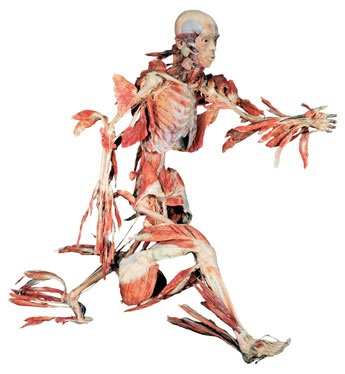
In July Aya and I went to an art show called Body Worlds in Niigata. I have known about Body Worlds for about 5 years, and have wanted to go for just as long, but was never able to be in the same city as one of the rotating exhibits. Luckily for me, Aya got some free tickets through work. I have always been interested in anatomy, my favorite part about creating art is exploring the human body. Seems only natural that as a human I am interested in what is inside of me. However, many people don't feel this way and would label that kind of curiousity as morbid or grotesque. I can see why people feel that way, but I don't share their opinion as art, and inherintly this exhibit, are not meant to disgust, but educate.
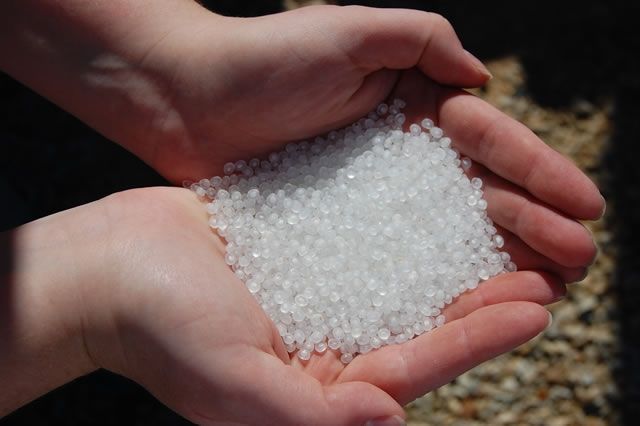
Most of the bodies in the exhibits are human, though animals do make an occasional appearance. The bodies in the exhibits are preserved by plastination. Plastination, in a nutshell, replaces the fats and water in tissue with polymers. The person to popularize the show and invent the technique of plastinization is Gunther Von Hagens. Currently there are 5 shows touring the world. All cadavers are donated and if you are interested in making a donatoin you can go here (http://www.bodyworlds.com/en/body_donation.html)
I expected this show to be breathtaking and I admit that it was very interesting, but there seemed to be something missing for me. Perhaps, life? But really I think what was missing was a true sense that these models were human. Even though the evidence was right before my eyes it was hard for me to believe that these were real human beings. I enjoyed looking at slices of people, a smokers vs. non-smokers lungs, women and men, brains with alzeimers, holding a brain in my hands, and seeing the blood vessels of the human body displayed independant of the torso in what looked like red hanging moss. I think its an important exhibit and I think most people, rather than leaving uneasy or deomoralized, leave feeling the real beauty and fragility of the human body.

Thursday, June 17, 2010

Shanghai's Maglev


Imagine if you will that you have put your ear to a seashell and are listening to the sounds it makes, that is kind of what the Maglev from Pudong airport to Shanghai proper sounds like at full speed. Maglev stands for Magnetic Levitation. Cars and tracks are designed to levitate the cars and for propulsion through magnitics. Some people refer to these trains as a linear motor car, but I don't think that is correct as linear motor car refers to the mode of propulsion (propulsion coils) rather than to the tracks and cars. Then again we call one train a steam engine and another a diesel even though they may run on the same track, so as you like.
The one in Shanghai is currently the most famous although there are other famous maglev trains such as those in Germany and Japan. The top speed ever recorded for a maglev train was in Japan at 581 kilometers per hour which in miles is something like 360.
This particular one transports people 30 km (18.6 miles) to the airport in just 7 minutes 20 seconds, achieving a top speed of 431 km/h (268 mph), averaging 250 km/h (160 mph). It is the fastest commercial train currently in use. I have to say that at the moments during which the train achieved top speed it didn't feel like it. It was suprisingly smooth.
We took the train both in and out of Shanghai, it was not so expensive, about 50 rmb which comes out to a little less than 10 dollars a ticket. I suppose if you had the time you would take a normal subway into the city, but we wanted to ride the special train. We thought it would be fun and it was.
The reason for being in Shanghai was to visit a school to see if I could get a job there and I did, so next year I can ride the maglev quite often if I like. I am sure with the number of people that said they would visit we will be riding it a few times at least. I am hoping the ride, in Shanghai next year, will be suprisingly smooth.

Saturday, June 12, 2010

Kodo


Last weekend before heading off for China Aya, her parents, and I went to a concert for a group called Kodo. This group is very interesting for a number of reasons. First is that the name Kodo can interestingly have two meanings that both fit the group very well. The first meaning is "heartbeat" which is easy enough to see fits a drumming group and the second means "children of the drum" which is even more obvious. Second, the group is based on an island in the Sea of Japan/East Sea called Sado. Sado is about a 1 hour ferry ride from the mainland and if you go back to a post I wrote in September you will see that I have visited Sado. It is interesting that the group is based there because there is not a whole lot of anything on Sado, which makes it easy for them to live a secluded and spartan lifestyle. Also very interesting is that apprentices who hope to be players spend two years living together communally in what was once an abandoned schoolhouse. After this period, apprentices who have been selected to become junior members spend one more year training and practicing in the hope that at the end of the year they will be chosen to become part of the Kodo organization. Members are very dedicated! The most visually interesting thing is the players endurance. Members will at times strip down to fundoshi, which is like underwear, and play. When this happens you can see the physical strength it takes in the contours of the players well muscled bodies.

The performance was beautiful and I was very glad to have seen it. There were songs that sounded like falling rain, traditional songs, and some that were very intense. The endurance of the players was quite impressive! It made me miss Japan even though I still have another 2 months here. If I ever get a chance to see Kodo again I will leap at the opportunity. If you would like to learn more about Kodo or hear some of their music you can visit their website here.

Saturday, May 29, 2010

Bees


Last weekend Aya and I went with her parents to local honey/bee farm to do some bee keeping. This place offered to show people the colonies and let them try honey, we were pretty sure it was meant for kids, but sounded so fun. So off we went.
When we arrived we had to don some funky net hats to make sure that we didn’t get stung on the face, but our hands were left exposed. As the woman guiding us got her smoker going she was telling us about the bees and that we shouldn’t stand in front of the openings of the hives because the bees would feel threatened. There were maybe a dozen boxes each containing its own colony with its own queen. She led us into the middle of the hives, or apiary, and I must admit that I was pretty nervous. There were bees landing all over me and the noise a bit unnerving. Plus, I thought, “Can bees smell fear? Didn’t I hear that once? Oh no, … don’t be afraid, don’t be afraid, stay calm.” That isn’t exactly true. Bees can smell pheromones, but they can’t smell “fear”.
Anyways, as we stood there our guide pulled out a board from the hive and showed us some honey comb, pointed out the queen, then punctured a hole in the honey comb exposing some fresh honey and told us to put our fingers in to taste some. I was the last to put my finger in and I must admit it was awfully hard not to poke a bee as I was trying to get some honey, but it was really good. Our guide explained to us about workers and drones and told us that essentially males are used just for breeding and once their purpose has been served they get kicked out of the hive where they starve to death. In some ways I feel bad for them, but not really. There lives may be shorter than other bees, but all they do is eat and breed. Sorry guy, I don’t feel bad for you. So I was thinking about whether or not I would actually want to be a male honey bee when Aya got stung. The strap from her camera and squeezed a bee between it and her hand and it panicked and stung her. Of course then our guide got to tell us about how when a bee stings and they lose their stinger they also lose their lives.
Other than that though we had a good experience and after went into the honey shop to taste some different kinds of honey like mikan, caramel, shiroka, soba, etc. They were all pretty interesting. We also read about some of the other uses of honey such as for medicine, shampoo, and other things. So that is the buzz on my honey bee experience.

Thursday, May 06, 2010

Stranger Danger


That is a picture of what I call the "stranger danger pole". This name is the name used by the foreign teachers that I know here in Japan. The real name is sasumata, which translates as something like "pushing fork" As you can see it is a long pole with a semi-circular shape on one end. The user grasps the pole on the other end and uses the semi-circle to pin someone by the waist to a wall or basically to push them away, all the while the user can keep a safe distance from the person being pinned.
In Japanese schools, as in every school, there are school drills that are conducted at fairly random times to make sure that the students are prepared in the case of a real event.
Fire drills at my school are pretty cool actually. One of the staff sets off big smoke bombs in a certain part of the building, say the upper west hallway, and then the fire alarm is pulled. Teachers and students have to figure out how, based on the smoke, they should evacuate. I think this is brilliant, but there is one major flaw. At my school the gymnasium is the evacuation area. The gymnasium is attached to the rest of the school.
There is another drill where we practice what to do if an intruder comes into the building. In this scenario, again, no warning is given. Across the anouncements the principal announces that there is an intruder. Students then have to, again, figure out how to get to the gym and avoid the intruder. The kids get to the gym and then the intruder (a teacher wearing a partial face mask and hat) enters by a side door and proceeds to hurl insults at the students and teachers and basically to act mean and threatening. At this point the intruder is subdued. Teachers surround the intruder and try to talk them down, eventually someone physically subdues the intruder. The "stranger danger" poles are always on hand and occasionally used. I have never used one myself, never even been in the act of subdueing the intruder. The closest I got was running around the school with the secretary, each of us with various office equipment as weapons, try to flush out the intruder.
The funniest part about the intruder poles is that they sit in a closet except for the day that they are brought out to subdue the intruder. They are not even handy should someone come in. On top of that, there have been numerous times when I have seen people just wander into school. Its always some nice old guy selling flowers or something, but the point is that there is no barrier to them coming in nor is there much concern when a stranger is seen in the hallways. The doors are unlocked and really anyone could get in at anytime that school is in secession. I don't mean to belittle the Japanese school system for trying to protect the students, but perhaps more should be done to ensure the safety of schools.
I actually asked Aya if she had these in school when she was young and she said no. The reason being that they came about because of violence in schools here, especially the Osaka massacre in which 8 elementary children were stabbed to death. In America and some other parts of the world there has been similar desires to respond to school violence. While I agree that measures need to be taken in schools I think Japan's most appropriate response is to examine the country's social policies regarding the treatment of mental illness. Often I hear people say that times have changed and usually I think that times really haven't changed, just the amount of people and therefore the amount of exposure to atrocity. However, when I hear about things like the Osaka massacre I have to wonder if maybe they are right.

Tuesday, May 04, 2010

Hanami


It is usually this time of year in Japan when most foreign people sigh and think; I really like Japan. It is also this time of year when most Japanese people think, I am Japanese.

The reason for this is hanami, or flower viewing, which really means the viewing of the cherry blossoms. From late March to May cherry trees in Japan begin to bloom. It is also this time of year that weather starts to become warmer. The sakura (cherry blossoms) because of the variations in latitudes and therefore climates, bloom first in the south of Japan and then creep northward ending in Hokkaido in May. Sometimes on the news you can even watch the “hanami front” as it creeps northward like some lovely pink army.
The flowers are very beautiful and many people like to picnic under them. At times the places with many cherry trees can look like a giant party as many groups will be picnicking at the same time. Unfortunately the flowers only last for about 2 weeks before they fall off. This also can be a beautiful time as flower petals falling resemble snow and hanafubuki, or flower blizzards, occur in high density areas.
I took the picture above in Ueno Park about one month ago. I had just arrived back from Australia and had time to kill before my bus. I thought the park would have some good flower viewing and I was right. There were lots of people there, everyone having a good time. I bought myself a beer and some yakisoba, a noodle dish, and sat under the trees enjoying my food and the view. As I sat beneath the trees I thought to myself that this might be the last time I see these trees for a while. If all goes to plan I will return to the US in August. So, with that in mind I sighed and thought; I really like Japan.

Thursday, April 15, 2010

Slaked


As usual reading has brought me a wealth of information. While in Tokyo the other weekend I picked up a couple of books, one was ‘Earth in Balance’ written by Al Gore back in 1991. At first, I didn’t know the publish date, I just picked a random passage, liked it, and bought the book. It wasn’t until later that I figured out how old it was, but I decided to give it a go anyways and I am now glad I did. It offered me many things to think about and explore. What really interested me was that, writing in 1991, Gore had many of the same concerns that the public at large today has about the environment. It made me laugh a little bit. I have great respect for Mr. Gore and I have always thought that he is miles ahead of anyone else when it comes to the environment. However, I am getting away from the point of what I wanted to write here. I wanted to write about water. All water really, but fresh water specifically.
In his book Mr. Gore identifies global warming, and specifically access to clean water, as being one of the major environmental changes happening on our planet, but of course the book is almost 20 years old. That got me to thinking about water and if the situation had changed since 1991. It also got me doing some research and I think what I found is pretty interesting.
Water obviously makes up a huge portion of our planet’s surface, roughly 2/3. It also makes up a large part of our body, roughly 2/3. Of the world’s fresh water roughly 2/3 is locked up in ice. Of the fresh water we use roughly 2/3 goes towards growing food. See a pattern here? I just thought that was interesting and would grab your curiosity. Now that I did (I did right?) let’s go a little deeper.
Of that 2/3 of the planet covered in water a meager 2.5% is fresh, and of that 2/3 is locked up in ice, leaving only 1% of Earth’s total water at our disposal. Of that 1% at our disposal we use 2/3 of it to grow food. Now when I say ‘grow food’ I bet you all got a picture of a plant in a field receiving water. Maybe you even got a picture of biting into a nice juicy tomato or something. I know I did when I first heard that statistic, but that isn’t exactly correct. Remember that after all the grain and veggies in the world are grown we still have billions of livestock to give water, and grain, to and there are far more livestock than there are human beings. So here comes the part where all the numbers start to paint a picture for change.
To make one pound of beef it takes about 1,857 gallons of water to grow and process it. To make one pound of beans it takes 43. Ok, yes, beef and beans are not exactly the same things, but I think you see where I am going with this. Pork is 756 and corn 109. Chicken is 469, potatoes are 31. Animal’s non-meat products like cheese and eggs fit more in the middle averaging 250-400 gallons per pound. I got all those numbers from National Geographic, which proved to be conservative in their estimates compared to other sources. I hope I am making the point that meat takes a lot more water to produce than veggies. To quote the most recent National Geographic, “A human diet that regularly includes meat requires 60% more water than a diet that’s predominantly vegetarian.”
I think that illustrates that point well enough, but I would also bet that most people reading this blog feel pretty secure in getting enough clean drinking water, along with all other water needs, to not be too concerned about how much water it takes to grow food. Most of my readers don’t live near the Yangtze, Ganges, Indus, Yellow, or Mekong rivers, but about 2 billion people do live close enough that they get their water from those rivers. Himalayan glaciers, which supply the bulk of those rivers, are melting faster than they can be replenished which soon will leave hordes of people without water, likely within the next 50 years. I will also assume that none of you have a relative among the 3.3 million people who died from water related diseases last year or that any of you have to walk the average 3.7 miles to fetch water that most women in developing nations do everyday. On average an American home used 100 gallons a day so you probably aren’t living on less than 10 gallons a day like billions or other people do.
However, I think I can assume that you live in Europe, Japan, or North America and therefore I have something for you to think about. It terms of virtual water, which is water used to produce and process products, Japan imports 15 times more water than it exports. North America is a net exporter of water while Europe is a net importer, like Japan but not nearly as much. That means, North Americans, that you have access to more water than you know what to do with. It also means, Europeans, that you don’t, and that of course also means in the near future that it could become a big problem considering some of the places where your virtual water comes from, like Africa and SE Asia. Not that North America is in the clear. California, which supports the U.S. by providing half of its nuts, fruits, and veggies, is facing a water crisis. I may also mention, while I am at it, that California has the world’s 10th largest economy, and therefore a large chunk of the overall U.S. economy as well as the world’s. That should be a concern given its recent and lasting drought. North Americans should also be concerned for other reasons having to do with fresh water. Of the animals on the threatened and endangered list in the U.S. most of them live in fresh water and those are going extinct at a rate 4-6 times faster than those who don’t. Species diversity is a key to most healthy environments and the loss of that diversity should be a big concern. The great Ogallala aquifer is the largest body of fresh water on Earth, and it lies underneath some of the richest farmland in the world, the American grain belt. But things are changing. The Ogallala is a fossil aquifer, which means the water in it is left from the melted glaciers of the last Ice Age. It's not like a reservoir or river, which is replenished regularly from rainfall. When the water in the aquifer is gone, it's gone.
So what can you and I do about it? Well it seems simple enough, but just think, the amount of moisture on the earth has not changed. The water that the dinosaurs drank falls as rain today. We aren’t likely to find new major sources of water anytime soon (although the moon has our hopes up), so we have to figure out how to live more efficiently with the water we have. Desalination plants process water consumed by 300 million people annually in 150 countries and that number is growing. That is one possible solution. Another solution is to repair aging infrastructure so that water that is piped for direct human or agricultural consumption use isn’t lost along the way to leaks and evaporation. The water piped into N.Y. City, for example, loses tens of millions of gallons a day to leaks. We can take many small personal measures as well. Everywhere you look today, particularly in the western United States, people are seeking to conserve water. You see people washing their cars less often. People are installing low-flow showerheads and sink fixtures and low-flow toilets. You see people using drought-resistant landscaping. The vigilant turn off the water at the sink when brushing their teeth, except to rinse the brush, and when shaving, except to rinse the blade. Perhaps they are even using grey water in their homes or cities.
These measures are prudent and helpful, but all of them combined don't save anywhere near the amount of water you would save by shifting toward a plant-based diet.
Of course not all livestock is raised off the Ogallala aquifer, and of course meat isn’t the only source of wasteful water practices, but it is a very powerful one and it is one that is easily within our own power to change and quickly. Remember what I had quoted from National Geographic? It said, “A human diet that regularly includes meat requires 60% more water than a diet that’s predominantly vegetarian.” The words used are regularly and predominantly. You don’t have to give up meat entirely, but eating a diet that is largely vegetarian is a huge step towards water conservation. So much in fact that it would save more water than if you never showered all year.
To quote what I am told is an old Chinese proverb, “Unless you change directions you’re apt to end up where you’re headed.” Well, it seems that I am getting more and more concerned about the direction we are headed so I wrote another post about the environment in the hopes that we can change directions. I say we because we are sharing the same boat. Many of the people that I end up talking to about environmental issues get defensive. I don’t really understand this. Isn’t this our environment? Shouldn’t we all be concerned? I never provoke a discussion and never make efforts to put people on the defensive. I am not pointing any fingers that I don’t readily point at myself. This is meant to be a discussion, not a debate. I would never say, you can do better, but we can do better. I think that is fair, but people still feel defensive. Maybe it is the idea of change more than anything else that puts people on the back foot. I think what people want to defend is nothing, or rather, doing nothing because that is more comfortable and less scary than confronting reality and making changes. I understand that feeling, but I just can’t do that any longer. When my kids or other future generations look back at me I want to be able to say, I did something. I was open to change and concerned about the future. So I will continue to explore how to make positive changes and to write about what I find in the hope that you, my dear readers, will read this and think to yourself, maybe I too can make some of these changes. For honestly, I have found that these changes are not as scary as they seem.
So here I am again, asking you all, please find ways to conserve and look out for the future. Don’t use as much and the water you do use, try to recycle before dumping it down the drain and please cut down on the amount of meat you eat. I have been eating vegetarian for 4 months now and I don’t regret it. I don’t think you would regret giving up meat a couple days a week to help conserve water, but maybe you, and certainly I, would regret you not showering all year.

Sunday, April 11, 2010

Sydney


What to say about Sydney? It seemed like a really nice city and Aya and I enjoyed our time there. Before coming to Australia I read a history of Sydney, which is really the history of the beginning of European settlement of Australia. It was quite interesting. I enjoyed much of the story, but was quick to note two pieces of trivia about the name Sydney. First, the city is named after a lord Sydney of England. This is funny to me for two reasons. First, he never saw Australia and second it wasn't even his real name. He had changed his name mid-life. The second bit of trivia is that the city was not intentioned to be called as such, it was supposed to be called Albion. Sydney was just the name of that particular cove, but the name caught on.

We decided to stay somewhere nicer than usual and booked into the Lord Nelson Hotel. Located in the neighborhood of the Rocks, in a building that was about 150 years old. Coincidentally it was really close to the original site of the first settlement.The hotel was nice. Our rooms were small, but comfortable and there was a bar on the first floor serving delicious beer and a barista on the second floor with some tasty food.
Since we only had 1 full day in Sydney, the first day we got there in the early afternoon, we decided to make the most of it. On the first day we just wandered around the Rocks neighborhood which had great views of the majestic Harbor Bridge and the Sydney Opera House. That night we caught a night cruise on board a Captain Cook dinner cruise. I was unsure if the cruise would be worth it since it was about 80 dollars each, but it turned out pretty good. We had a 3 course meal that was well made and we could drink as much as we wanted. We also had a nice view of Sydney Harbor as we made our way first to Darling Harbor and then out to Port Jackson. When we started it was dusk, but by the time we returned 2 hours later it was dark. Both evening and night views were great.

On the second day we walked around some parts of Sydney going to the Aquarium and China town in the morning. I had found a walking guide online and although we didn’t follow it to the letter we took some of the directions found therein to make our way around. In the afternoon we made our way the Australian National Museum. It was pretty cool. They had an exhibit where various animals were displayed as only a set of re-constructed bones. I think bones are fascinating. There was also a nice exhibit on Aborigine culture and displays of Australian mega fauna that I quite liked since mega fauna is really interesting to me. It was a good walk, but by the evening our feet were getting tired so we took a subway back to Circular Quay. We managed enough energy to walk midway across the Harbor Bridge, which had a great view. That night we ate at the bar in the hotel, having some pizza and olives that were delicious, along with some delicious beer made on property. Unfortunately we didn’t have much more time and the next morning I was off to New Zealand and Aya back to Cairns to catch her flight home.

A few of my friends, jokingly, have said that it’s a bit strange that I posted first on New Zealand and it has taken me so long to post this one. Perhaps that I didn’t say much about Aya is what they find strange. Aya is becoming like my right arm. It just seems normal to have her around and when I went to New Zealand I was a bit lonely. Traveling was still fun, but not having someone to share the views with didn’t feel quite right. Coming back to Japan and finally meeting up with Aya was a bit of a relief. As much as I grumble about not having enough alone time it seems that I have come to enjoy her company.

Thursday, April 01, 2010

Reef


The Great Barrier Reef is the world's largest reef system and is composed of over 2,900 individual reefs and 900 islands stretching for over 2,600 kilometres (1,600 mi) over an area of approximately 344,400 square kilometres (133,000 sq mi). If you are like me then when you see those numbers it is pretty hard to imagine the exact magnitude of that area, but gosh it seems big. To give you a little perspective to think about this my dear readers. The state I was born in, Wisconsin, which most of you know, has an area of approximately 169,639 km (65,498 sq mi)Meaning that the reef is more than twice the size of Wisconsin. Pretty darn big. The Great Barrier Reef can be seen from outer space and is the world's biggest single structure made by living organisms.
This reef structure is composed of and built by billions of tiny organisms, known as coral polyps. These polyps secrete calcium carbonate which becomes what we think of as coral, that skeletal type substance. Over time coral grows quite large and needless to say (yet I am saying it) the environment around them grows with them which also makes the reef one of the most active places for aqautic life.
The Great Barrier reef, being enormous, supports an enormous diversity of life, which is why every year hordes of people flock to the Coral Sea, off the coast of Queensland in northeast Australia which is just near where we happened to land.
I guess "happened to land" isn't exactly accurate. It didn't just happen by accident, Jetstar chose it for us. You see Jetstar is a budget airline and hence they service places where lots of people go or places where they want lots of people to go like Cairns, former or latter if you like.
We flew into Cairns from Narita airport and spent 4 days in the region. Sometime was spent relaxing and some riding a train into the nearby village of Kuranda, but the main day was the one we spent on the reef, or rather on Franklin Island. We had booked into a tour that would take us to Franklin Island, just a bit off the coast. Here there would be lots of coral and beaches to be enjoyed. The island is actually part of many along the coast. Often, after long periods of time the coral grows, the sands shift and bang! In the blink of the Geological eye an island/cay is formed. The tour company did a good job in getting us there nicely and servicing us with lunch. They even provided a very good quiche for the vegetarians! They also provided guided snorkeling and a guided island walk. Both were good. The seed pod seen in Aya's hands above, for example, was pointed out by our guide. It's designed to float and thereby get to other island where the tree can sprout. Nature is so good at that! Our guide seemed very well versed in his job and he pointed out many things that I found intriguing.
The downside to this magical adventure is that at the time there was a cyclone south of our location in Queensland and so the water was not clear. Snorkeling was a bust, to see the reef at all you had to dive down about 2 meters. However, on the leeward side of the island we did see some sea turtles poking about among schools of fish, so that was cool and really we just had a good day swimming about and enjoying the pristine beach. At the end of the day we returned satisfied and I, because of my snow white skin, returned back to Cairns burned a shade more red.