This past weekend Aya and I spotted that we had a good air day coming in Beijing and neither of us had obligations, so we signed up for Beijing Hikers to do a hike north of the city in the mountains. We have been living in Beijing for almost 3 years and most of that time we talked about doing one of these hikes, but the air is always a toss up and most weekends I work so time kept ticking away until this weekend we finally had the opportunity to go. I signed us up via the Beijinghikers website and we were put on standby for that Saturday's hike. Most hikes fill up 5-7 days in advance. Lucky for us they decided there were enough people on standby to get another, smaller bus to follow their regular large one. We took a car down to the Lido hotel in Beijing where we met up with other hikers at 830. After about 20 minutes of checking names and handing out bananas everything seemed in order. So, two buses with about 40 people, we headed north to Little West Lake. It took about 2 hours to get there with a potty stop mid way. Most of the drive was through the norther burbs of Beijing, familiar territory for us.
The drive was fine and we started our hike near the top of the mountain. There were not many other groups on the wall or first part of the trail, but in true Chinese fashion those people who were there were chatting noisily and a few of them were blaring music from devices as they hiked breaking the serenity. Also in true Chinese fashion, people never gave way if there was only room for one person to pass on a trail, if they decided to sit for a rest it was always right in the middle of the trail, and a lot of the people I saw hiking just threw their trash on the wall or off the side and there were areas were you could see it was thick with trash. Hey, it's not my country, but if it were...
The first part of the hike we spent 2-3km on a restored part of the wall. It was pretty steep going up and down between towers and took us about 1.5 hours to get through that bit. The next part, where our guides had held up the lead group, was a little bit of a fairly flat stretch through some orchards. That only lasted about 1km before we were back up on the wall, this time an unrestored section. Again we encountered many Chinese hikers. Another 1-2km along the unrestored wall and we could see the end, a ticket shed at the bottom of a steep descent. Once our group came together there we walked the last part of the hike, all flat along a lake and through a park that was packed with people, and then to the parking lot.
After we got all our people together we boarded and had a short drive to a place to have lunch. By then it was about 3pm, so a pretty late lunch, but a few people in our group straggled so we were a bit behind. Lunch was at a local place on a balcony overlooking a reservoir, so pretty nice view and the food was good. After lunch we packed in the buses to head back to the city and most everyone fell asleep from food and weariness. As we approached the edges of Shunyi we asked if we could jump out. It seemed like an odd spot, but it was only 4km from there to our home whereas the bus was going downtown which would probably mean another 45 minutes to get there and then another 45 minutes to turn around and come back to Shunyi. It was no problem to just jump out and from there we took a cab back to our apartment so we were home by 530pm.
Overall I liked the hike and might do one again if I can find the time, but I'm not sure if I want to. Driving out of the city, then being surrounded by Chinese crowds is not exactly a stress reliever. One of our guides was asked if he had been to the Ming Tombs (a popular tourist spot we passed on the way) and he replied that he never had nor would want to since it would mean crowds. He then went on to say that despite living in Beijing for 8 years he had hardly went to any of the touristy spots because he couldn't stand the crowds. I agree, so if we go again we will aim for a place that is a little more off the beaten path.
A few weeks ago I ran the Great Wall (1/2) Marathon. Last
year I had prepared for it well in advance, but about 6 weeks before race day,
just as I was really ramping up my training, I had a calf strain. The thing is,
I didn’t know that. I spent the next month or so trying to rest then run again,
rest then run again, rest and run again. After a couple of tries I knew I
wasn’t going to make the race and so took a rain-check for 2015. Over the
summer I again tried to rest and run with longer periods of rest, but nothing
seemed to be working. In the early fall I started to see a physical trainer and
she told me about the strain. It took about 3 months of weekly visits for
massage, ultrasound, and rehab to get me back ready for running shape. By late
November I was running again, slowly, and by late December my single run
distances were creeping back to double digits. So, with that in mind I signed
up again for the Great Wall race that was to take place in May 2016.
Throughout January I wasn’t pushing anything, but just kept
running regularly to get myself back into a good spot for when the real
training began. From February to May, roughly 15 weeks, I went from about 20km
a week to almost 65km. I topped out my practice run about 10 days before race
day at 22km running, about 5km uphill with roughly 30 minutes of stair work in
the middle to represent the course to put me in a good position for tackling what
the race would throw at me as I knew from the course description there would be
an uphill stretch followed by lots of stairs and then a long flat portion.
Unfortunately, being Beijing and China, the air quality
forecast was showing very unhealthy conditions for race day. I can’t express
how furious I was that after all that rehab and training I might not end up
running the race because of the chance of bad air quality, but I figured
anything could happened and I should at least get to the race site before
deciding not to run in toxic air.
The day before race day I went straight from work to the
Beijing Int. Airport to catch a bus to the race site. The company that runs the
race offers a few options, but as someone living in Beijing I didn’t want to
make my way downtown to stay in a hotel only to get up at 3am to take the bus
to race site. Nor did I want to arrange private car which would require me to
leave around 330/4am. I opted to take the bus out the night before and stay in
a Hostel that the race organizers had set up. Finding the bus to the race site
was easy enough and the ride was about 2.5 hours. When we arrived in Huangyaguan
it was dark and as soon as we arrived our guide had mysteriously disappeared.
The bus arrives in the main square where the entrance to the wall is located,
but those of us on the bus were booked at different hostels and none of us
really knew where to go. Luckily someone in the group spoke mandarin so they
rang up our hostels and got vans to pick us up. I rode alone to my hostel and I
am not sure if any other racer was staying there, but I imagine so. It was a
nice little place and interestingly had a huge rectangular bed, in China called
a “kang”, where about 6 people could have slept side by side. It was just me,
but that was lucky since the bed was rock hard and I had to use the additional
comforters that were provided to cushion my backside. Facilities were about
what I paid for, roughly 40usd. There was a tv, a wet shower, toilet (no paper,
brought tissues), and sink. Unfortunately, it was also about 15 feet from the
main road and the trucks rolling by all night didn’t provide the best sleep,
but good enough and better than I would have had getting up at 3am.
I was in wave 1, surprisingly to me, which meant that I
would start the race at 740am. I say surprisingly because that was the fastest
wave of runners, the first to go and expected to be the first to finish. Prior
to the race I had to submit my fastest time for ½ marathon which is currently
1:50. From this the organizers must have derived that I would be one of the
faster runners and as it turns out they were pretty much right, but I was on
the slower end of the fast people. I woke at 6am, ate my normal pre-race of
oatmeal and coffee, then packed up and started walking up the street to the
race. Luckily the north wind had blown a bit in the early morning and readings
were showing, “moderate” air pollution. It looked like conditions would remain
that way for a few hours, then go back up to “unhealthy”. Good enough, just.
By the time I arrived it was about 7am. Like any good
pre-race routine, I went to the bathroom about 3 times in the next 30 minutes,
dropped off my luggage, and had a short jog and stretch to get ready. Once
runners were let into the first gate I ran into my friend John, whom I teach
with and was running the full marathon. He would eventually finish the marathon
in about 6 hours. That is a respectable time for this course, it’s a killer.
The winner of the marathon came in at about 3:40, an astonishing time as the
course is punishing. After listening to numerous speeches and getting riled up,
it was time to start.
Like all races, the start is exhilarating. I took off quite
well and was feeling great. A couple KM in we were through the village and
crossing a bridge where our ascent to the wall would begin. The next 5km or so
was uphill to the gate to the wall. There were many people along the route
cheering us on and that was cool, but in true China fashion when I was about ½
way up the hill a 2-stroke tractor came puttering up and kept pace with myself
and other runners, puffing black smoke clouds in our faces. Great China air
conditions. On the initial take off from start I passed a lot of people and
going uphill I pretty much kept my place, neither passing nor getting passed
too much. As we entered the stairs to the wall the race was slowing down. On
the wall itself there is barely any room to actually run. You are either going
up a set of stairs that is just a bit too steep to run up, or going down a set
that is just a bit to steep to run down safely, with bits about 30 feet long in
between where you can just get running before hitting another set of stairs. This
portion was nice, lots of people cheering us on, and the views were good. You
could see at lower levels down the valley was a bit smoggy, but up by us looked
pretty good. At the end of the wall is what is called the “goat track” which is
basically a steep set of stairs going straight down from the wall to the square
where the race begins. You make a circle, in other words. This bit was pretty
hard for me and I was not prepared for such steep downhill running. I was going
slow at this point and lots of people were passing me, but they were not going
too fast either. Upon reaching the end of the goat track you hit the flat bit
of the wall by the square where the race begins. This is tricky as after going
up and down for the past 5k or so you now are back on flat ground and it was
hard for me to get my legs to adjust.
Once again you go through the same gate you start from. It
was at this point that I was getting a little frustrated. I had hit a couple of
water stands and was keeping hydrated, though the day was getting hot, but the
race course also was supposed to have gel stations and bananas. I could not
figure out where those were as each stand I passed was just handing out water.
It was until further on, around 13km, that I found a stand with bananas and so
grabbed a bunch. The course moves back through the main town and along a dirt
road by the river, then across the river and through a small village before
returning again. It was by this point, about 17km, that I was starting to get
tired and irritable that I hadn’t packed gels myself beforehand thinking they
would be readily available on the course. I stopped to walk for a few minutes
and then stretch before keeping going. Eventually I got to 19km and seeing the
end was near I put on the gas to finish in 2:38. I am happy with that time as I
wasn’t sure how long it would take, but I told myself under 3hrs for sure,
under 2:45 respectable, under 2:30 would be quite good. So, good to respectable
given my expectations. Overall I was 151st of 484 1/2 marathon runners.
After I finished I had a shower on site, very handy, and
then grabbed the provided lunch of Subway sandwiches. I waited some time for my
friend John to come running through, but unknown to me he would be out another
3 hours. Eventually I made my way to the buses departing for Beijing airport.
Another 2.5 hour bus ride and I was at the airport, then a 30 minute taxi and I
was back home in Lido. Overall I am very glad I did the race and am planning
some small ones over the summer, hopefully getting back to a 1/2 or maybe full
sometime in the coming year. It might be fun to do the Tokyo marathon again
someday or perhaps something new. I will never do the Great Wall Marathon again
nor any other race in China for one reason, air pollution. I got somewhat lucky
and the heavens parted on race day for me, but the air still wasn’t that good
even in the mountains. Predictions had the AQI at possibly over 200, or “very
unhealthy”. In developed countries no race would go forward at that level, but
in China that’s not uncommon. Last year the Beijing marathon saw levels at
350ish during the race, considered, “hazardous” yet people ran, some with masks.
Its just not worth training for months only to have terrible pollution on race
day and not run, or alternatively to run 21km with a mask on. Gross. Until
Beijing can get skies in China clearer, I’m steering clear of their skies.
After visiting the bridge I entered the grounds to the old Wanping fort. One thing I was immediately impressed with was that the city walls had remained, largely, intact. This is strange because just about everything in Beijing, regardless of historical significance, gets torn down in the name of progress. It was kind of cool to be in the old walls. I walked quite a bit to the museum itself and when I arrived at the front gate I was told to go to a small side booth to buy a ticket. Inside they asked for ID. I didn’t have my passport, but I did have a copy, which they took down the information from and issued me a ticket, no charge. I was then directed to go around the side of the building to enter from a somewhat basement entryway. At first I thought, oh, this is going to be bad. Most of the display was poorly reproduced pictures, no English text. After milling about there for a few minutes I saw people where ascending a stair so I followed and ended up in the main part of the museum.
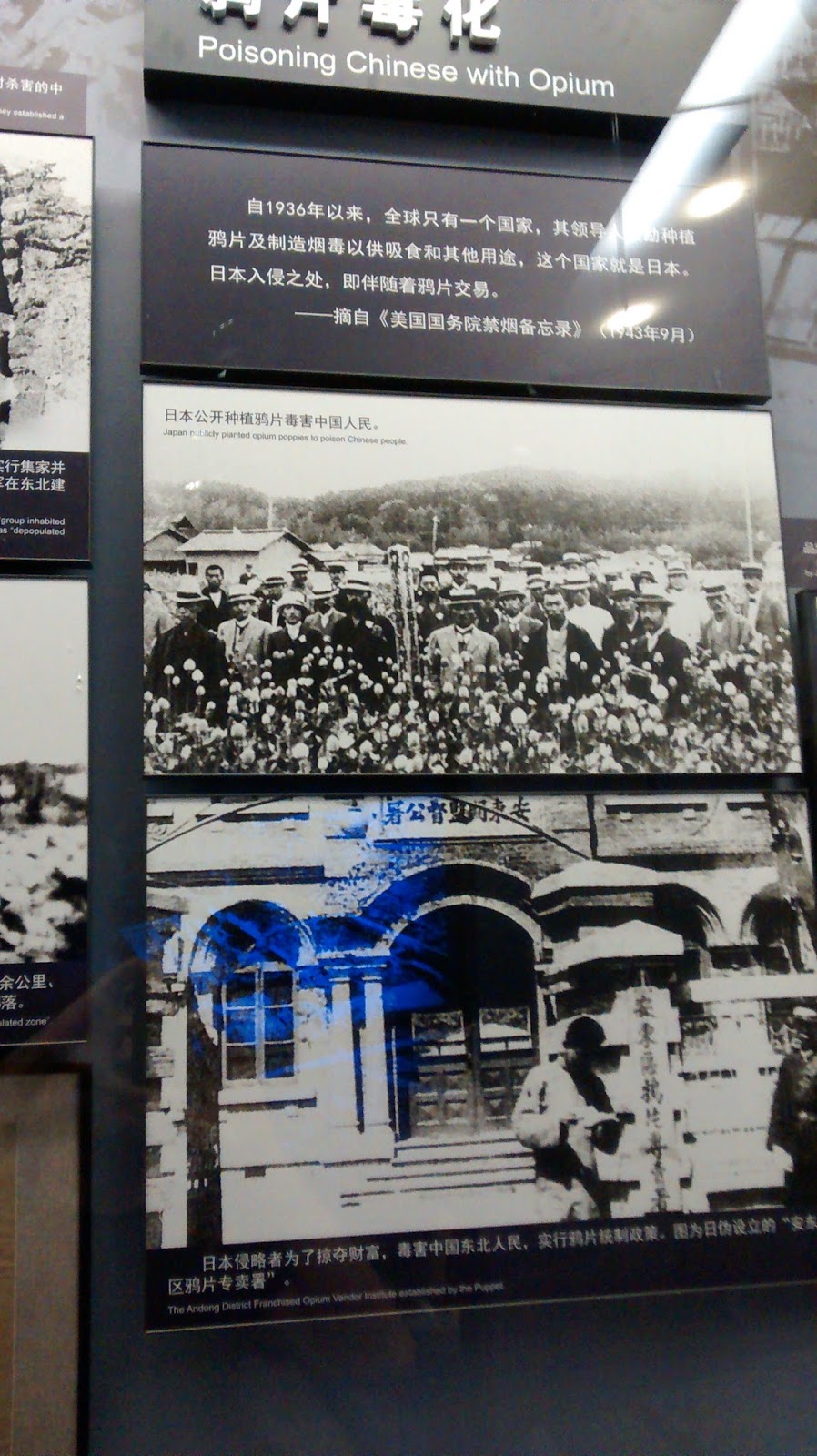
The museum is indeed quite big and actually well put together. Displays of relics, lengthy descriptions, many in English were all around. As I walked around the museum I was kind of expecting some ultra nationalistic displays, but that didn’t really happen. Most displays were straightforward. Many other tourists were there as well and I got a couple of “Haaallooo” from visiting students as well as two gents who asked to take a picture with me. At a tourist attraction, even the tourists themselves can be something to see. I like to think I am hanging on that gents wall somewhere, maybe his office, and he tells people about the business ties he has or something like that.
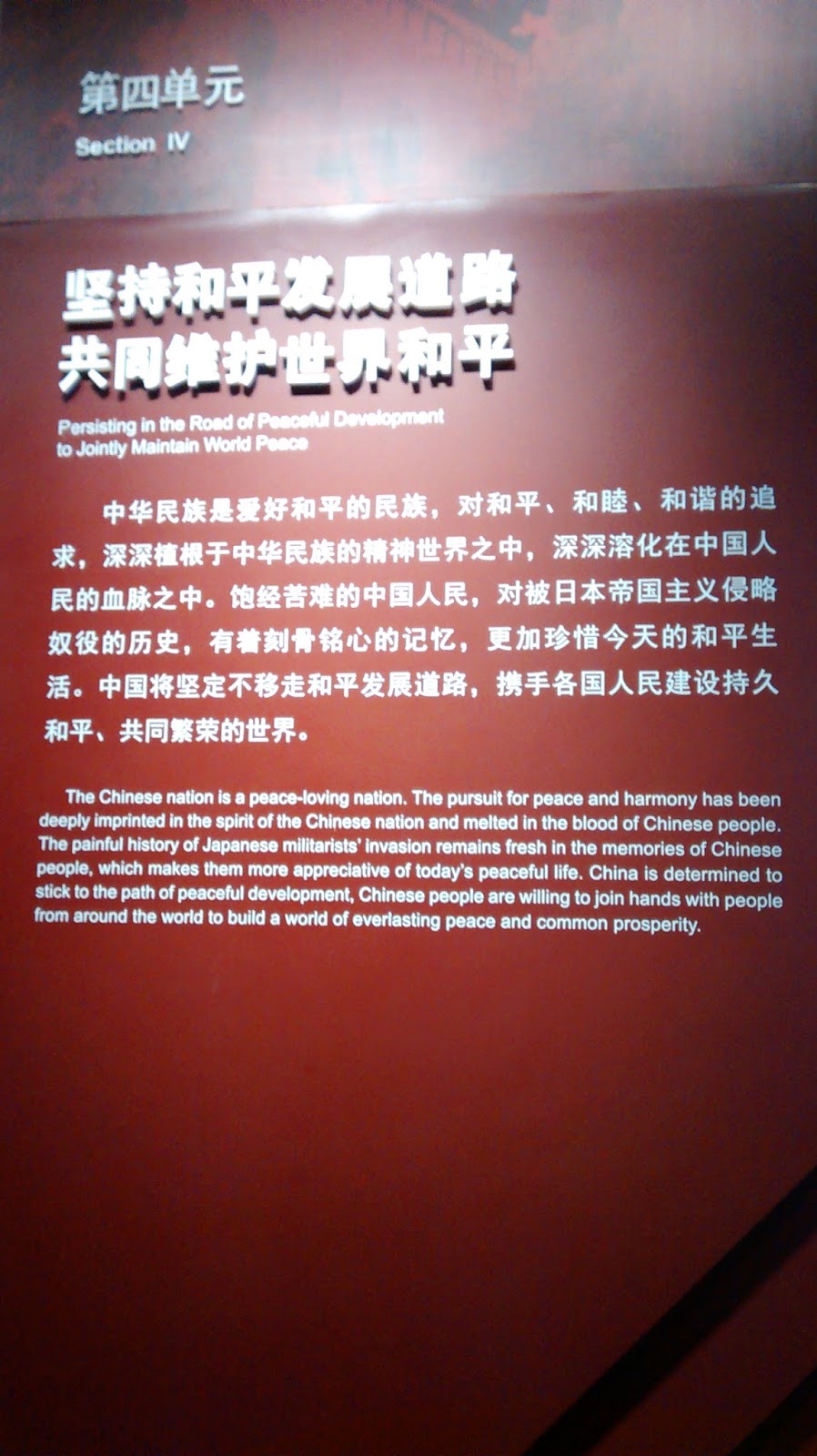
I was getting to the end of the museum and thinking, oh, that wasn’t nearly as bad as I thought it would be and then I came across it. In the last room before the exit, there is a display of Japanese and Chinese relations over the years and how those relations have gotten better, but also ways in which Japan has provoked China. One of the first displays says, “The pursuit for peace and harmony has been deeply imprinted in the spirit of the Chinese nation and melted in the blood of the Chinese people.” Ok, great. Then a nearby panel states, “The painful memories of the Japanese invasion remains fresh in the memories of the Chinese people.” So which is it, have theChinese people forgiven the past or are they still holding on to painful memories? The hall was a sour end to the museum, which was largely impartial. Relations between China and Japan are provoked by both sides, but most Japanese people couldn’t care less about China. The only times I every heard anything about it was when the ultra nationalistic citizens black bus rolled around, slogans coming from their loud speakers, but the thing is that every person I talked to about that bus said they were nutters and did not represent Japan.
On the other hand, since I have been in Beijing I have been discomforted by China’s unhealthy obsession with relations with Japan and other nations. As China has gained power, they have also started to push. Push to forget China’s past, push their territory in the South China Sea, and push for a better international standing. This hasn't gone down too well with everyone outside of China, but in China it has created solidarity among the citizens and I would guess an external enemy on which to vent their frustrations, rather than the party.
I've had a number of people, unprovoked, tell me they don't like Japanese people. I've seen bumper stickers denouncing Japan. Of course, this fall there was the celebration of anniversary of the end of the war with Japan which was understandably a momentous occasion for China to celebrate, but to have a military parade to mark the event was beyond the pale.
The other day I was having breakfast and reading the China Daily when I came across this op-ed piece, about the upcoming visit from a Japanese politician. It was incredibly sour in its tone.
If you look at the article in the China Daily you get phrases like, "To put an end to the finger pointing circle, Japan, first of all, must stop encroaching upon China's strategic interests... because China is willing to and well capable of safeguarding its sovereignty." Hearing, seeing, and experiencing things like this in China really make me questions if, “The pursuit for peace and harmony has been deeply imprinted in the spirit of the Chinese nation..."
A few months ago I visited the Museum of the War of Chinese
People's Resistance Against Japanese Aggression. I had been waiting for a day
when I had lots of free time and the air was nice. This is a rare combo in
Beijing, but it finally came. It took me quite a while to get there as its on
the south west side of Beijing and where I live is on the north east, basically
as far opposite as one can get. When I arrived at the nearest subway station I
wasn’t quite sure if I was in the right place, but I did finally arrive at the
Marco Polo bridge. The bridge dates back to 1189 and is somewhat famous in the
modern context because it is where the Japanese invaded Beijing and in an
ancient context because Marco Polo commented on it in his travels, hence the
modern unofficial name. The bridge itself has been restored and looks quite
nice. Lucky for me there were not too many people there so I got a little quiet
time. One thing I was a bit perplexed by, the maps show a river that the bridge
crosses, but it was more like a pond. One end of the river was clearly dry. Why
build a bridge? Seriously though, Beijing is getting drier and drier. Maybe
someday in the near future the bridge will span a sand dune. When I looked this
up I came across the gem of a description, “In recent years, the water of
Yongding River has been diverted to different areas of Beijing so often there
is no water under the bridge.” Apparently there is not so
much water under the bridge (Ba-dam-ching!!), because right across the street
was the war museum.