Sunday, August 19, 2012

Meanwhile Back in America


This summer Aya came with me to America for the second time. The first time was just after we had started dating, her English wasn’t as good, and I was very busy seeing friends and family. This time around we had roughly the same amount of time, but all of those things had changed. We did still see a lot of family, but this time it was as my wife and I think she was more comfortable with our relationship and her language ability was definitely stronger as well. Aya got to eat American style, chase around nephews and nieces, and practice driving on the right for the first time. She also got the full experience of the Hurley family as my grandmother and a bunch of other family from that side came to meet her for the first time. As per my own experiences I have a few observations about America. Since it has been some time since I have been back and each time I feel a little more distant there were things that struck me as being “American” vs. just something that I was used to. The thing most on my mind is of course food. It was great to be back in the land of every flavor and variety, but I gained almost 10lbs in 6 weeks. Americans eat way too much meat, not that I ate any of it, but they do. Every restaurant and grocery was packed with meat. On the other hand, things that aren’t explicitly meat as a rule do not contain meat. This is not so in other places. America does a good job of telling you exactly what you are consuming. There are labels everywhere, but apparently not enough people actually read them or care enough about how many calories they are consuming. It appears that now everyone has a tattoo. I understand why some people get tattoos, but I think a lot of people get them to be individuals, which is now a moot point since so many people have them. Many of them are also ugly and ill placed on the body. I will never get a tattoo. I went to the movie theater twice and both times was aggravated that most people in the theater left their trash in and around their seats. Why!? Is it so hard to pick up your cup when the movie is over and carry it with you the 30 steps to the trash can on your way out? I don’t understand. Another thing I don’t understand is the lack of sidewalks. America is built for cars, which doesn’t work out very well for you if you don’t have one. I have learned that cars are a big waste of money and energy. Public transportation is awesome, when it works, and every major city should be pushing the cars out and the trains and buses in. Which leads me to my most felt but probably least shocking observation; Americans are wasteful. Big houses, lights left on, too much food, cars too big, not enough public transportation, way too much air conditioning, etc. People are terribly concerned about fuel prices, but don’t see the link between consuming fuels in ways other than a gas tank that then contribute to higher fuel prices. I also enjoyed some things about America. One thing I loved about America was the effort to provide for different lifestyles. Every grocery and major restaurant had something to offer for me as a vegetarian. America has a huge variety of food choices and choices in a lot of other areas too. It is a consumer’s paradise. People in the US have it so lucky, but most don’t know it because they rarely look outside of the US. Even the poorest Americans have access to clean water, clean air, and a land where social mobility is still possible through education and hard work, even if it is less than other developed nations. I think more than anything else this trip put into a better perspective what it is that America has to offer me. I will likely always be American and America will always be my homeland, but the more time I have spent outside the U.S. the less I have felt compelled to return. I spent a lot of time with other teachers and with family which gave me an insight on what life might be like if I moved back. From a teacher’s angle, things are dark. Teachers aren’t well respected or supported in the U.S. Most states are facing budget cuts which are forcing them to stop hiring and sometimes cut back on the number of teachers they have. In addition, unions across the country are feeling the crunch from right wing politicians and a down beaten populace led to believe teacher’s salaries are cushy . This despite that almost every report you can find lists teaching as one of the lowest paying jobs given the amount of education required and time dedicated. Sound bites make for better news than actual research though. Students’ attitudes are getting worse, according to almost everyone whether or not they are in education. America itself is a mixed bag. I have family there which compels me to return and the ease of access I have to anything I want is amazing. However, gun nuts, religious nuts, political nuts, and the overall animosity towards intellectuals and social responsibility in America continues to turn me away. I don’t know what the future will bring. Perhaps in 2 years I will be accepting a job back in America, but for now it’s just a nice place to visit.

Saturday, August 18, 2012

NEH Chinese Film and Society


This summer I had the opportunity to participate in an NEH institute on Chinese Film and Society, which was held at the University of Champaign-Urbana. It had been suggested by my department head at school that I try to apply to summer programs like those she had done with Fullbright. Unfortunately there were not many programs available with them, I was also a bit late in exploring my options. There website did contain links to other programs such as those by NEH and so I had the chance to apply to two programs. Those two were on Chinese film in Champaign-Urbana and another held in Ohio, the topic of which was Central Asia. I was not accepted to the institute on Central Asia, but was accepted to the institute on Chinese film. I must admit I was a bit disappointed at first. The Central Asia program ran 2 weeks and the Chinese film one for 4 weeks. This would mean if I attended the Chinese film one I would have less than 2 weeks to spend with family before having to move on to Malaysia. However, I thought it was a great opportunity and so jumped when they invited me to attend. Over four weeks, twenty or so participants watched about thirty movies interspersed with lectures and discussions. While this was happening we formed small groups in which we planned lessons around a particular film. That material should be published through the NEH website, when I don’t know. We are also now returning to our classrooms to share this information with our students. I can say that I thought I knew a lot about China, but something I didn’t know very well was how the Chinese view themselves. Through a lot of discussion with other teachers and listening to lectures, I learned much more about Chinese society. I also spent a lot of time in the evenings with a few particular guys and that was nice to make some new buddies. We went to the roller derby, tractor pull, to the Springfield Lincoln memorial, and many nights on the town. I truly enjoyed the program and if I get a chance to I will apply to future NEH programs. If you want to learn more about the program, visit this site

Tuesday, July 31, 2012

Tractor Pull


This past weekend I went to the Champaign County fair with a few friends from the NEH institute. Two were New Yorkers and one Floridian. The Floridian was the most keen to go and the other two were just along for the cultural experience. They had never gone before and were curious to see this event. I remember going with my dad when I was a kid, but mostly what I remember is that the races were too loud. It is funny coming back to America after 5 year of being mostly abroad. There are certain things about America that I can very clearly see in a cultural light now. Tattoos, large serving sizes,striking up conversations with strangers, all those things aren't as normal in the places I have been. Certainly I haven't seen any tractor pulls. At the tractor pull just about everyone I saw in the grand stands was fat. Interestingly I saw what I would dub a "mega cup" for the first time and then saw another one just a few minutes later. It looked like a plastic coffee mug, but was big enough to fit a 2 liter bottle of soda. Judging by the guys holding them I'm sure the were packing it away. The tractor pull itself was interesting, for the first 15 minutes or so. After the first few people went and we got the jist of what was going on the event became rather boring. I suppose for those involved and probably for people who are interested in farm machinery and mechanics this would be a cool event, but not for us. The two New Yorkers put it best. One said, "I can't believe people do such a thing" and the other one made a comment about how when the announcer said stuff like, "Look at him go! what a competitor!" the only thing happening was a guy driving a tractor at about 15mph. I was a bit indifferent, but my butt was getting sore (not enough padding, maybe I should have bought a "mega cup") and so when they suggested we leave I was all for it. The Floridian hadn't had his fill yet and wanted to see the semi-truck pulls, but decided to come with us. All in all, a nice night enjoying American culture.

Springfield


This past weekend I took a trip to Springfield with a few other members of the NEH institute. Its not a long trip from Champaign-Urbana to Springfield, just under 2 hours. However, we started the day late and so arrived around noon. First we went to the Lincoln home. The home and many of the homes and area around it are part of a national park. Because of this our tour guide was a national park ranger. A bit of a funny guy. The Lincoln home is fairly small when compared with today's homes. We were reminded again and again about not touching things and which parts of the home were authentic and which were not. I had a bit of a flash back to being on the Fox Glacier in NZ. Every time the guide asked a question I answered it, no one else did. It occurred to me after the first few that perhaps the questions were rhetorical so I stopped answering, but I don't think they were. My impression was that the house was not that big or fancy. Then again, Mr. Lincoln was not that fancy (but certainly was big at 6ft 4inch). I remember seeing a billboard one time that had a picture of Lincoln. Underneath it said, "Fail, Fail, Fail, Succeed" Implying that you should not give up on your dreams. The meaning in the Lincoln connection was that he lost three other elections before accepting the nomination to run for president in 1860. As the guide told us over and over, Mr. Lincoln was a lawyer in Springfield when delegates visited him to ask him to accept the nomination. Another striking thing was that on election night Mr. Lincoln was out until 4am waiting for results. Today we have so much in the way of technology to keep us connected. Back then the best way to talk to someone was to knock on their door. Along with the couch that Lincoln reclined on and other interesting items I also saw the Lincoln outhouse. Presumably it once contained some Lincoln logs. Ba'dam Ching! After looking around the Lincoln house and neighborhood we went to the Lincoln museum. We didn't have too much time but I was impressed with the detail and presentation. There were two main sections, one devoted to his early life and one devoted to his presidency. Both were very interesting. I found the sections on cartoons drawn of Lincoln and the room made to seem like he was lying in state to be the best. The cartoons were funny mostly because those were probably the only images that most Americans saw of Mr. Lincoln. There was one little series where portraits of him went from haggard looking to handsome with a quote underneath that said, "The closer he gets to being elected the more handsome he becomes". Luckily today we have 24/7 television to remind us of which candidate we should vote for, based on their looks. Probably the neatest fact that I learned at the museum was that the picture of Lincoln lying in state was not even discovered until the 20th century between the pages of an old book. Makes you wonder what is still out there or what has tragically been lost. My overall impression after seeing both places was that Lincoln was just a man. A very witty, probably smart, freakishly tall for the time, ordinary man. His kids busted up his house, his wife gave him hell from time to time, and he sometimes did things just because he knew he should.

Thursday, July 26, 2012

Chicago Rock n' Roll Half Marathon

Here I am in Champaign-Urbana at the university campus doing a program with other teachers and of course everyone knows that I am heading to Chicago for the weekend to run the half marathon so the question comes up, when did you start running? I remember it quite clearly. I was 13 and I have a friend named Tim Roberts. His dad was a runner and would do 5ks a few times a week. Sometimes Tim ran with him so Tim was a bit of a runner. Personally, my dad wasn’t around too much since my parents were divorced and looking back I think in some ways I thought it was cool when older guys took the time to do things with me. When Tim asked if I wanted to go running with him and his dad I jumped at the opportunity. That run didn’t go so well since it was my first long run, but it sparked something inside of me. Even though I don’t think I ran with his dad again I did continue to run with Tim and then to just run in general. That is how it started. Here I am 17 years later and still running. Sometimes people ask about my knees or tell me that I will get old and stop some day, but I just don’t see that happening. At the very worst my knees will give out and I will start riding a bike or something else. I don’t see regular exercise becoming a small part of my life. I love using my body. Now, I’m not crazy, but I do get the itch to run if I haven’t done so for a day or two. I think this is a good thing. As I stood on the start line with more than 20,000 other runners this past Sunday I felt really good to know that I was not alone. Races are very interesting because at least 99% of the runners know full well that they have no chance of placing. Yet people show up in hordes. People basically race themselves, but I think more than that I and they enjoy the camaraderie and the feeling of community. Running can be a very lonely sport. That is one reason I like it. This is my zen time. I get to get some endorphins pumping and let my mind find a special place to relax and I run alone so no one is talking to me. Getting into a large race and seeing and feeling the crowd can also be exhilarating and I really enjoy doing it from time to time. The Chicago Rock n’ Roll half marathon was a nice race. It was very flat and since I got a room at the Travelodge hotel just blocks from the start I didn’t have to wake up early. As I sauntered out with other runners I was greeted by a sunny warm morning. The race went well and there were lots of water, Gatorade, Gu, and cooling stations along the way. I started out in corral 11. I like to start with a group that is slightly slower than me so that I can pass people along the way. It makes me feel like I am moving fast and I think gives a better race experience. I finished in 1:58 and was happy with my time since I was aiming for under 2:00. A bit faster would be nice, but maybe next time. I also got to stop midway to see my fan group, my mom and nephew. It was cool to stop for a few minutes to talk and have a drink. I think my nephew really enjoyed seeing me and the other runners, he seemed to be excited. Overall a great day. Now, on to the next race.

Tuesday, July 17, 2012

Roller Derby

I'd never seen roller derby in person, though last year I had seen the movie 'Whip It' and that had piqued my interest. The idea of tough girl athletes playing a game that was physically on par with hockey seemed pretty cool to me. Last saturday I attended the farmer's market here in Urbana and the Twin City Roller Derby girls had a booth to encourage all comers to their match the next day. How could I pass up a cultural experience? I went with some of the other guys at my NEH institute in Champaign for a night on the town. We had heard that there would be a roller derby match at a nearby rink and 5 of us went. Mostly we all had preconceptions of tough girls, with tattoos, beating each other up. Though that did happen a bit it was more fun to watch the sport of the game as well. It took us most of the first half to figure out the scoring, but once we did and once we all had our favorite girls picked out it was a lot more fun because we could cheer for the appropriate people at the appropriate moments. I would have to say the girl I chose, Black Eye Betty, must have been the MVP of the game. I don't know how many points she scored as the jammer for the Damagin' Dames but it must have been at least 40 of the team's 109 total. If you have never seen roller derby I recommend it. I will be going back to see another match at the end of the month. If you would like to know more about the sport, check this out.

Thursday, July 12, 2012

Toronto to Niagra


I did not get to spend a lot time in Toronto. There for a just a few days and adjusting my clock the maximum 12 hours, I had trouble doing much of anything besides enjoying early morning runs by the lake and walking around the downtown area. I was there for an IB conference and that was productive
I learned a few things about IB Econ, but probably equally as well I met a lot of good teachers. One in particular stuck out. He was going on his first teaching job abroad, to Hong Kong, and was very excited. He expressed how nice it was to be among teachers who were globally minded rather the teachers he had been around for the past few years. He expressed it very succinctly by saying something like, these people do the same thing all the time you know? Every year they look forward to the same vacation in the same place because it’s something safe that they know. Lots of teachers in the states don’t like the state of education, have a hard time finding a job, don’t feel respected by their students, but they are afraid to try something new and foreign. I think in many ways he is right. Besides getting to spend time getting to know the teachers I spent some time getting to know Toronto. Toronto transit is too expensive and too small. In addition, not many people were riding. Even during peak times it wasn’t hard to find a seat. Probably because of the aforementioned reasons. Lots of people smoke on the streets. You would think coming from Shanghai, where you can smoke almost anywhere, this wouldn’t strike me as odd, but it did. One day on the way back to the hotel I had that thought and the next day it was confirmed as a fellow classmate from Montreal said he was surprised by the number of smokers, or at least their lack of hiding it. The people here are diverse. I was quite impressed with the diversity I could see and more so with what I could hear. Korean, Indian (hindi), Spanish, and French were very common, but I also heard some Chinese, Japanese, Russian, Arabic, and German. The city itself was nice. There were plenty of parks and open areas. I really noticed this when running. In Shanghai it is hard to run a longer distance because the buildings hem you in and you can’t see your horizon. It feels like you run to nowhere. In Toronto horizons were broad. I could pick a point a few miles away and see it for most of my run. I like that as my destination markers are constantly in my vision. Since I was in Toronto I decided to go to Niagara Falls as well. It was probably one of the most anti-climatic things that I have done. I don’t mean to say the falls were not impressive, they did look very nice and I think they are the biggest falls that I have ever seen. What was anti-climatic was the way I approached it. I took a bus and walked to the falls. No tour, no big thing. I sat looking at the falls for a short time and then got lunch before heading back to the bus terminal. I could be completely wrong, but I have a nagging notion that my grandfather spent his honeymoon at the falls and so I was thinking of him a lot when I was there. Something clicked for me as I was leaving Toronto. I no longer wish to come back to the U.S. I still miss my family and the friends I have there, but for all the reasons that teacher I met said, I don’t want to come back. I don’t want to come back to a profession that is not respected. I don’t want to come back to insubordinate students. I don’t want to come back to pay/benefit cuts. I think more than anything else I don’t want to come back because now I am enamored with the idea of seeing the world. It's better than any perk I could get in the US. I am moving on to my 5th country in a few weeks. That will be the 22nd country I have entered and I am sure it will lead to seeing a bunch more in Southeast Asia. I have to wonder what this will mean for my future. Since leaving the U.S. 5 years ago I have had a vague feeling of, at the very least an obligation that I would return. Now that that is gone, what will the next chapter bring?

Saturday, July 07, 2012

RMB to USD

As I was leaving China I encountered a dilemma. I had saved a substantial portion of my earnings in RMB intending to convert it to USD before I left for the US. Because RMB is a controlled currency it is not as easy to convert
as in some countries. I met a few roadblocks, but more than anything I thought it ridiculous that I could not easily find an answer on the net so I am writing this and tagging it in the hopes that if someone does a simple search like I did they may find this information. First, if you are exchanging less than 500 you can go to any bank yourself with just your passport. You need no other documents to my knowledge. If you are exchanging more than 500 here are some ways in which you can do that. 1.Find a Chinese citizen. They may use only their ID card, or their passport, to convert any amount of RMB to USD. However, fair warning that not all banks carry a lot of USD. Call ahead or be prepared to hop around to different banks until you find one with enough. 2. Get from your employer a letter of resignation, basically it is a letter saying that your contract is ending. Take this along with your employment verification book (its a little red book that looks like a Chinese passport), your tax documents, your original employment contract, and your passport to a bank at which you have an account. 3. Exchange the money at the airport. They will do any amount for anyone, but their rates are not very good.

Monday, July 02, 2012

Nanjing

This past weekend I took the fast train from Shanghai to Nanjing. The best part is I did so with my old friend David. You may remember him from other appearances in my blog such as here,here,or here. I must admit it took me a couple of hours to shake the dust off of our relationship. Its been more than 2 years since I have seen David, but by the end of the trip we were like peas and carrots again. David is extremely useful to travel with in China since he is near fluent in Mandarin. I even remarked at one point that I would like to shrink him down and put him in my pocket to which he replied I should just learn more Chinese (I maintain shrinking him would be easier). Our first night in town we didn't do much beyond get some street food eats, drink some beer and hang out. We tried to go to a trendy part of town called 1912 but the beers were way over priced, 30kuai (about 5 dollars) for a 350ml Chinese beer. That is a 900% mark up! No thanks. The second day in town was our touring day and we walked everywhere. We went to the Sun Yat Sen memorial where we had our picture taken many times. I know I am handsome, but that was too much. In some parts of China people are still drawn to a foreign face. I don't think Nanjing is one of those places, but at tourist attractions you will find people from those places since they are likely coming from a more remote area. The memorial itself was cool and once you have reached it at the top of the hill there is a nice view of Nanjing. The most surprising thing for me was that on the ceiling of the tomb is a flag of the Kuomintang, otherwise known as the nationalists in China's civil war. After the memorial we went to the Nanjing Massacre Museum. Perhaps it is because we had both read and seen much about it prior, but it did not strike either of us as overly shocking. Of course I don't mean to say that the actions of the Japanese troops aren't shocking, but hearing about many of the atrocities before hand certainly lessened the shock. I also expected a bit more anomisity towards the Japanese, but I didn't find anything that I would have considered out of place or over the top in any of the placards or pictures. At least among the English translations, perhaps in Chinese the nuances are slightly different. It was around the time of going to the museum that David told me a story about his time in Beijing when he was a student. He was attending Beida University and sitting in on a lecture by a fairly liberal minded professor. One day the professor started talking about the Japanese and basically said that the Japanese people who committed atrocities in China were all dead and there was no point in holding it against those who are now living. To which many students stood and yelled at him that he was wrong. I'm sure it was an animated session. Many times when I encounter things like this, the memorial park in Hiroshima for instance, I think much the same thing. In my mind time periods are like different worlds. People had completely different experiences and perspectives and so people of a nation completely renew themselves every 80-100 years. This is also an apt time to point out how stupid it is to hate a nation. My grandfather fought against the axis in WWII. I'm not saying he hated them, but his country did demonize them and ask him to go kill them. His daughter married a German man and his grandson (me) married a Japanese girl. Different times = different worlds. Back on track, after the museum we had time to kill and so we decided to go to the presidential palace. I'm really glad we did. The grounds were beautiful, but the history was rich. The compound had been home to Sun Yat Sen,Chiang Kai-shek, and the leader of the Taiping rebellion Hong Xiuquan who believed he was the brother of Jesus. Long story short, it didn't work out for him. Having hoofed it all over Nanjing we went back for some rest at the hotel before heading out with David's friend for some beer on the Nanjing streets and then late night karaoke with another group. It was very fun. The next morning we headed out early and came back to Shanghai were I got to show David around Shanghai at YuYuan Gardens, the Bund, and to have a drink in the Financial Center tower. Everything went very well until I misjudged how long it would take for him to reach the station and he missed the last train back to Beijing. While this was fortunate for me since I could spend more time with him it meant wasted time for David. In the end everything worked out. I'm looking forward to meeting him again. Perhaps in a different time, a different world.

Friday, June 29, 2012

Xi'an

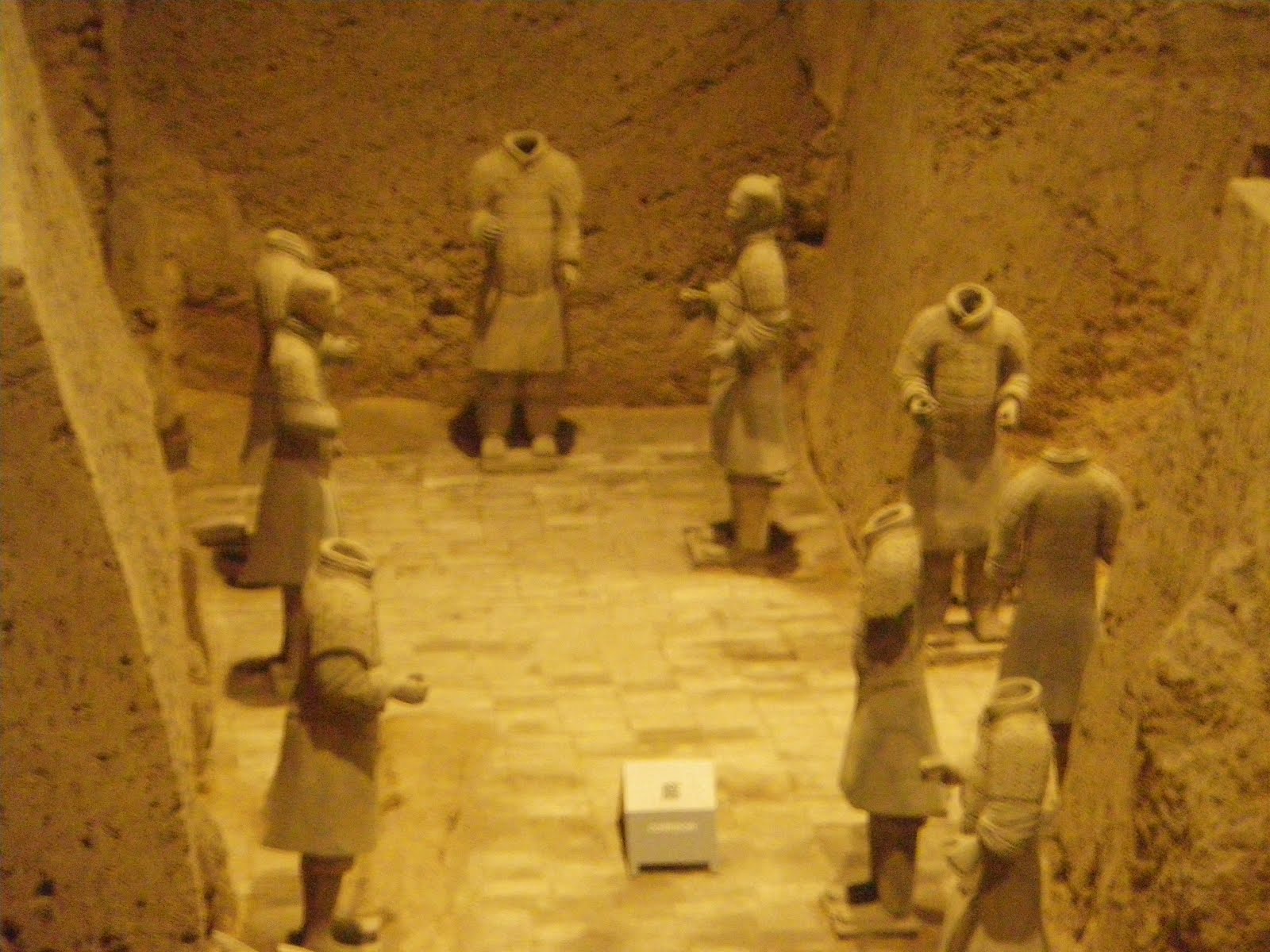
In our last full weekend in China Aya and I went to Xi'an. A few months ago, as it was sinking in that we were leaving, we sat down to decide what things we most wanted to do before leaving since we don't have any plans to come back to China in the future. Top of the list, get more foot massages, but second was going to Xi'an. Both of us wanted to go see the Terracotta Warriors. As a history teacher is was something I couldn't pass up. We booked our tickets and hotel and took a flight to Xi'an. Travel in China can be interesting. Before boarding we were standing in line when the 3 year old girl in front of us squatted down and peed on the floor. This is not unusual for China since most kids have split pants designed just for this. The parents then did nothing about the puddle of pee on the floor, also not surprising. Lucky for Aya and I we saw it happen and so avoided the puddle when the line started to move. Unfortunately a number of people behind us did not see it and rolled their luggage through and stepped in the pee. Once on the plane we settled in a few rows from the back rear the bathrooms. There are a few things I look for when I choose seating. First, I want a seat near the back of the plane. Odds are slim that a plane will crash, but your chance of survival is even slimmer if you are at the front of the plane. Safety first. Second I go for an aisle seat. I don't care to look out the window that much and I don't like having to crawl over people to go to the bathroom. I would rather have them crawl over me. Introverted tendencies second. Third, try to get a seat near an exit. Safety here again. So anyways, we sit down and are surrounded by a number of men who reek of tobacco but are otherwise nicely dressed. They are carrying small square suitcases with combination locks built into them. Thats all they have. It seem pretty odd. Mid-way through the flight one guy gets out some official looking documents that say, "flight plan" in the header. I'm guessing they either work for the airline or work for the government who is checking on the airline. Either way what happens next is interesting. I start to smell smoke. Not electrical wiring smoke, but tobacco smoke. Now, every flight everywhere starts with announcements about not smoking, fastening your seat belt, blah blah blah. I don't know when the last time was that you could smoke on a plane, but it was a while ago. I don't see the offender, so they must be in the bathroom a couple rows behind me. A few minutes later out comes one of the airline guys and now he really reeks like smoke. Apparently the rules don't apply if you aren't a paying costumer. So... Xi'an. It was hot and dry. My eyes were burning slightly the whole time, but it was also pleasant. The weather, not the burning. We did walk around the city a lot and see thing like the Bell Tower and the city wall and they were all cool, but of course the warriors are the stars of the show. We ended up booking a tour with a local youth hostel. In the morning we boarded a bus and headed out to the site arriving at about 10. There are three pits at the site each in varying degrees of unearthedness (not a word, but seems like it should be). Each pit in essences was the same, but each building was slightly different. We got to be pretty up close, but never within touching distance. The closest we could get was to a few they had in glass cases. The one picture is especially neat because it retained some of the paint on it even though the pigments usually crumble away when the statues are exposed. That one is also special because it was the first statue found by the farmer who was digging his well. Later on we went to an exhibition hall where the farmer had set up a table where he would sign books and you could take photos with him. In a way I thought it was kind of uncouth to charge for photos (thought smart and lucrative), but I guess I returned the rudeness by saying no thanks to the photo opportunity. The statues were pretty cool to look at and in one of the pit areas you could see the warriors that were being reconstructed. Two things struck me as odd. First is the picture of the figures without heads. This is interesting because they people for whom they were built weren't dead yet when the tomb was sealed and so they don't have faces or heads. The other was a thought that I kept thinking the whole time I was there. Why isn't the project finished? Surely after almost 40 years since the first discovery they could be done. Why aren't they? Couldn't they just hire tons of workers? I'm sure there are thousands of scholars around the world who would give up a summer or even years to come to Xi'an and remove dirt from fragments. I had heard that they were waiting for a technique that would reserve the paint since when exposed to air the colors deteriorate quickly. In any case, they were very cool. After the tour of the warriors we headed to the tomb of the Qing emperor, the one who ordered the building of the warriors. He believed that by drinking mercury he would live longer. It almost certainly shortened his life. It is interesting to think of how far humanity has come. The hill being held by Aya is his resting place and is supposedly surrounded by a mercury moat. The moat has leaked over time and the whole mountain is now highly toxic, but again I am left wondering why it hasn't been opened after such a long time. Surely the pros of opening the tomb and seeing what is inside would far outstrip the dangers of excavating a toxic site. Couldn't they just use chemical gear? After seeing the hill/tomb we headed back to town and the rest of the trip was pretty unremarkable. I drank some beer, we slept at the hotel, the flight back was fine, etc. Next up, Nanjing with David!Let the summer travel begin!

Tuesday, May 29, 2012

Summer Time

Summer time is fast approaching. About two weeks ago I got a little peeved at some of my students, I could tell they were starting to slack. Now, I am caught in the same trap. Not that I am not doing my work on time, but the summer is fully here and I am catching myself looking out the window hoping to lay in the grass or run my fingers through warm sand. Today it was 32C and sunny, no denying reality. Most of the furniture from our apartment is gone. It has been sold off to people here or coming, just a couple things remain. We actually sold too quickly and now are missing a couple of pieces we would like to have back. We are also wrapping up all the little intricacies of life here and getting ready to move on. Today I taught my last Economics class to this year's seniors. Still underclassmen yet to teach, but that section is done. We reviewed some test stuff for the first half and then I allowed them some time to ask some questions point blank. They asked about how I got into teaching, what I thought the future held, how I met my wife, etc. As I talked with one senior boy this afternoon I told him that I was glad to see them go, but sad, but feeling free and excited in a way too. It was kind of fun to find out the questions that had been burning in their minds. As I looked into their eager faces and thought about what the next couple of months held for them I also recalled that time in my life and how freeing it was to be moving on with a world of possibility in front of me. Here I am again moving on. In one month I will move away from Shanghai. First going to Toronto for an IB conference, then on to Champaign for a summer seminar with the National Endowment for the Humanities. I was accepted to study Chinese Film and Society for the summer. I am really looking forward to it. I will see a few friends and family and run a half marathon in Chicago, but mainly be in Champaign studying. At the end of July Aya will join me and we will go to visit family in Door county. It will be the first time she meets my father and that side of the family since none of them came to the wedding. We will spend about two weeks there, then on to Penang where a whole new adventure waits.
Its an upheaval and ultimately a step into the unknown. I am taking another risk, but hoping it will ultimately lead to greener pastures in the future. So far in my life, I have been lucky to be right about that most of the time. The times I haven't weren't pleasant, but were growing experiences. I'm hoping for the former. I guess overall I feel glad to go, but sad, but feel free and excited too in a way.

Monday, May 14, 2012

Suzhou to Wuhan

The past few weeks I went on two trips outside of Shanghai, to Wuhan and Suzhou. I went to Suzhou with Aya and I enjoyed my trip. It was high time I got outside of Shanghai, it had been about 4 months and I was feeling like the walls were closing in. Suzhou was a bit nicer than Shanghai in that its a bit smaller, has some older architecture, a lot more greenery. We didn't see too much, the main reason we went is so Aya could take a TOEFL test so we went Saturday, stayed over night, and then left on Sunday. As silly as it seems the most interesting thing we saw was probably when we came across a crowd gathered around a woman playing a violin. It took us about 5 seconds to realize that the woman wasn't actually playing the violin, she was just dancing around pretending to play it while a stereo in the background played violin music. Did no one else notice this or were they just so bored that they stayed to watch anyways? This is China. We did go to the Suzhou museum and the carved ivory tusk, pictured, was amazing. However, we quickly tired of the crowds and went back to our hotel. After laying around for a bit we went out for dinner. This is when I encountered the second most interesting thing about Suzhou, Guinness on tap and an Indian restaurant. It was a great dinner. The next day Aya went off to her test and I lounged around the room until I had to check out. Then I went to meet Aya. I met her at Suzhou university, a nice little place and we headed back to Shanghai. The next weekend I went to Wuhan with a couple of guy friends. The reason we went to Wuhan is that my friend Brian had lived there about 10 years ago. Just about everywhere we went in the city he had something to say about a store that had moved, a new one that had popped up, or a road that had been expanded. Wuhan has changed a lot in the past 10 years, much of China has. Wuhan is the setting for the beginning of the revolution, led by Sun Yat-sen, the deposed the emperor Qing and ended the imperial dynasty in China. We actually went to the hill where the first shots were fired from, but I can't for the life of me figure out why they would have chosen that hill. With all the trees in the way I'm not sure how they shot at anything. We also had the option to see the Yellow Crane Tower, but 80rmb a ticket dampened our spirits and we walked on. What we came upon next was a food bazaar. It was neat, turtle, rabbit, dog, crocodile, even snakes were on sale. I went with some fried rice, not much in the mood for dog. Afterwards we followed Brian around the city looking at places he used to work or that had changed since he was there. In the evenings we drank and played cards, not much else to do in Wuhan. Compared to 20th century Wuhan we no longer live in interesting times, I suppose. Or maybe they are. China is changing so fast, surely that is interesting in a good way. Listening to Brian all weekend I imagined that my friend David will sound much the same way when he returns this summer. The past 10 years has seen enormous change in China, I'm sure it will blow his mind. It certainly was nice to get out of the city, but trading one noisy, dirty, crowded place didn't do much for the senses. Riding the train back to Shanghai I couldn't help but think of how depressing some of these places are to me, but how wonderful they must seem to many Chinese people. I have one more destination before I leave China, Xi'an. Aya and I are off to see the warriors near the end of June. Maybe that trip will be a bit more interesting, but I wouldn't put it beyond grasp that we will see another fake violin player.

Monday, April 16, 2012

Shocked

These cartoons were made by my students. Earlier this year they had an assignment. Write a letter as if your friend was coming to Shanghai from a western country, how would they experience culture shock? They had good answers so when it came to write the exams the other teacher and I decided to add a little twist and put ourselves in the picture. I especially liked these. One I like because my facial hair is out of control.  Another I like because of the last frame with people walking around someone that is hurt (that happens). One I like other because of the phrase, “what in the name of Chiang Kai Shek!” and the last one because it was thoughtful. There you can see I am experiencing shock as someone eats spiders and I point, then I see people pushing to get on the subway and I point. Finally in the third frame you see a bus driver seeing me pointing and thinking, “I thought pointing was rude?” A great example of the different ways that people see behavior.  Culture shock has abounded for me here in Shanghai, mainly in a negative way. Most things I have gotten used to. Spitting, peeing in bushes in plain view, picking your nose in plain view, talking at volume 10, littering, standing in doorways/stopping at the mouths of escalators are all things I think are uncouth, but I quickly get over them. Probably the one thing that does continue to bother me is the way people push to get on the subway. Maybe this is because I am often directly involved. I would think pushing to get a seat would be rude, but perhaps rational. Pushing to get into a subway car when the people in your way are the ones coming out is just stupid.  In any case, I won’t have to deal with these things much longer. In two months I will be finishing here in Shanghai and then heading to the Canada and the US for some conferences and time with family. After that, we are heading to Penang. I’m sure a whole host of new annoyances await me, but at least for now I can imagine that nothing will bother me. Just to freshen up, I have order Culture Shock: Malaysia to get a handle on customs. I remember looking for customs for China and some of them are very true, like savings face, but most of the things I dealt with everyday I never learned in a guidebook. Thinking back, there are very few things I will miss about Shanghai, but I will miss my students. They have been some of the best students I have ever had. There is something about the Confucianism in East Asia which makes the students some of the best from a teacher’s point of view. Sometimes I think about teaching in the U.S. again and it makes me wonder if I ever can after being so spoiled in East Asia.  The whole Malaysia experience will be a fresh one. Neither Aya nor I have ever been to Malaysia and the job I am taking will be a new experience as it is in the IB system. We are probably heading in other new territory as we intend to stay for a while and to start a family, but I think that is all better saved for a future post.  For now I will enjoy the things I do about Shanghai, especially my students, and dream of the summer. It is almost here. 

Sunday, March 11, 2012

Ano hi

Today is a day for remembering, “Ano hi”, that day. Along the tsunami-battered northeastern coast, in Tokyo and elsewhere, memorial ceremonies were planned to mark 2:46 pm, the precise moment the magnitude-9.0 earthquake hit on March 11, 2011. One year ago I was in Beijing with the school's MUN team. I was on my way back to my hotel when I got a text from Aya that there had been an earthquake in Japan. I though, so what, Japan is earthquake central. I turned on my tv as soon as I got back and expected to see little if any coverage, but what I saw was a writhing black monster sweeping across Tohuku farmland, picking up houses and cars like they were toys and smashing them to bits and I cried and yelled at the tv before calling Aya and getting on to FB to try and contact friends and family. Now, one year on, Japan is still recovering. I saw it this past summer when I went back to volunteer and I see it still in the articles and news programs I read and watch. Hundreds of thousands left displaced or homeless, tens of thousands dead or missing. For some people, there will never be closure. I remember that while I was standing in Narita airport waiting to come back to Shanghai, I read an article in GQ that I will never forget. It told the story of parents of children who had died, one of which was deeply sad. A mother whose child had been found among the debris was trying to clean the black slime of the tsunami from her daughter and licked the sludge from her eyes. Many of the stories I read were equally, deeply, personal. Despite a triple disaster that would have crippled the determination of other strong nations, Japan marches on. The people move as one. They are selfless and hard working, willing to endure and hoping for the future.

Monday, February 06, 2012

CNY

Chinese New Year is the most important calendar event in China. It marks the beginning of the new year, the first term of the solar term and marks the end of winter. Never mind that it takes place in January, if the Chinese say its Spring, collectively, it is Spring. Fifteen days after the beginning of the CNY is the Lantern Festival, which marks the end of celebration. People buy all sorts of things for CNY, it’s like Christmas in the U.S. Families gather together and have a feast while red decorations sporting sayings like, “good luck”, “wealth”, “happiness” are put around homes and entrance ways. This year is the year of the dragon, so there are an awful lot of dragon decorations too. I even made one myself.I took foam board and cut out pieces, then fit the pieces together. Anyways, back on topic. There are two particularly spectacular things about CNY as I see. The first is that most people return to their home cities/villages to spend time with family. Think about Christmas travel in the U.S….. got it? Now multiply that by 4. Two billion journeys are registered by plane, train, car, bus, scooter, etc. Really, people pack up their belongings on a scooter, with the kids, and head for their home village. I’m sure it takes days, but hey, they get there. This is the biggest migration in the world and in Shanghai it’s easy to see. The days leading up to CNY see people frantically moving about, but the day after the holiday begins this place is a ghost town. The second are fireworks. Fireworks are supposed to ward off evil spirits and so can be heard many times throughout the year for various reasons, but during the CNY it seems like every moment of every day is filled with the sound of fire crackers going off. On the 1st night and 15th night especially, people pull out all the stops. This year we went to our roof at midnight on the first day to see the fireworks. Looking out across Shanghai, in every direction, where bright fireworks and the noise was deafening. It was beautiful. I’d never seen anything like it. Of course there are lots of negative side affects to this, it’s really noisy, for one and after a while it gets quite annoying because people light of fire crackers no matter what time of day it is. Apparently 5am is a good time to ward off evil spirits. I’m trying to sleep! It’s also putting tons of smoke into the already polluted air. Some estimates I saw put it at 50 times the normal level of pollution on CNY. There are also always lots of injuries and damage because, while many of these are heavy duty shoot up 100 ft into the sky and explode in a rain of burning embers type of fireworks it seems like anybody can light them off. There are some going off on the street corner by my apartment right now, literally showering people. I’m not sure if all this leads to “happiness” “wealth” or “good luck”, but an awful lot of people seem to think so. In all, I think it’s a special time of year, the city comes alive. I just wish they would keep it down a little. I’m trying to sleep.

Monday, November 21, 2011

The Still Point of the Turning World


The title of this blog comes from T.S. Eliot. He was talking about books and I think he was right. In this busy world books are something very static or at least they used to be. The idea of the book is now changing. What exactly constitutes a book? “Books” now can have many added features such as 3-D clips, embedded digi-vids, and recordable devices so a narrator can tell the story (presumably for parents and children). The format of what constitutes a book is changing.
Last fall I received a Kindle as a present from Aya. I love to read. I read in the bathroom, in planes/trains/automobiles, before bed time, etc. I usually am reading 2-3 books at a time and in an average year I get through about 50 books of varying size. So naturally the idea of the Kindle intrigued me. The main draw for me was that it could hold a lot of media in a relatively small device. I am often traveling and so this would be a great thing to have. Last summer I seriously considered buying one as I was going to be taking graduate classes and traveling at the same time. I certainly didn’t want to lug my textbooks around with me and the Kindle would have been perfect except that those particular titles weren’t in the Kindle selection yet. Therein lies one of the drawbacks. Despite the vast amount of titles available on the Kindle it is merely a drop in the literary bucket. So I didn’t buy it because of that, the price of most books on the unit, and the price of the Kindle itself. At the time it was around 200 dollars to buy a Kindle and some of the titles can only be bought for 9.99 and above via amazon while their paper editions can be found for 1 cent plus shipping.
By the time Aya got me my Kindle things had changed a bit. The price fell to around 175 dollars, many more titles were added to the selections, and they now carried MG3 which is basically the ability to access the internet anywhere. Part of the reason for the evolution of the Kindle has been the rise of other similar things such as the release of the iPad2 in 2011 and now more recently other book tableture devices like the Nook from Barnes and Noble . In many ways the Nook is comparable to the Kindle while the Ipad can function like a Kindle, but then it also has so much more. It has more connection to all the applications that you would normally use on your laptop plus the usual gadgetry of the iTouch.
Now Amazon has responded with the Kindle Fire which can be comparable in many ways with the ipad. However, the speed and dexterity of using the internet on a Kindle is not very good. You would not use your Kindle if a normal desktop was within any reasonable walking distance of where you stood. Nor would you want to type a long winded blog (such as this one) since the key pad is small. I would rather use my cell-phone than Kindle to type something. For using the internet my Kindle has come in handy on only a few occasions looking for directions and such.

That really made me start to think, what exactly is this Kindle for? Is it a book or is it something else? I guess it is no longer a book because it has internet access, but then again it is made to look and feel a bit like a book. It seems that the main intent of the Kindle is for it to be used for reading.
At first I was discontent with the slow and clumsy internet and keypad use on my Kindle but after considering it I think I am happy about that. In that way it remains more of a book because it discourages me from doing anything with it but reading. There are enough things in life to distract me; I don’t need the thought of being able to easily access the internet while reading to be one of them.

Considering my Kindle brought up two questions for me. First, will the book remain as it basically has been for a millennium? I would say no, but yes. Despite the fact that paper book sales are down 9% this past year I think yes, books on paper will continue.There are some things that electronic books just can’t do and do we really expect everyone in the world to buy an electronic device to read? I think not. You could also look at it from the angle of a connoisseur. Just because most people use CD's or electronic files these days that doesn’t mean that there aren’t those who buy vinyl. I had a great conversation with my boss the other day about how things have changed. She thinks books are on the way out, completely, and that they are likely to go the way of vinyl. That is collectors items, but not much else.(she was also, btw, the first class in her elementary school to use ball point pens instead of ink, think about that) She cited the fact that for our students books are not what they were to us. Every kid now has grown up from birth touching an interactive screen. Very soon we will have kids entering our high schools and then become young professionals, who have very little contact with a physical book.
Then again, books will change. With all the capabilities of what “books” could be there will inevitably be some tinkering. I think the change is good. Imagine a text book in which the diagram of a rain cycle that actually moves.That would be pretty neat. Maybe a novel in which Alice shrinks and grows as you tilt the book (already exist actually)

Second, how will this change our society? The French writer Jean-Phillipe De Tonnac says "the true function of books is to safeguard the things that forgetfulness constantly threatens to destroy." That is a very interesting quote, but historically i think books have allowed us to actually lose memory among individuals at the gain of society. If you think about the vast change that the printing press and hence the start of the mass distribution of books caused, well, that is massive. Information preservation was placed on a higher shelf (ba-dam-ba-ching!)and societies could more easily access the collective knowledge of people past and present.
However, something was lost with the invention of the book and that was part of an oral tradition based on memory so that quote by Tonnac could be turned on itself. People used to tell each other tales that were very long. Take for instance the Iliad and the Odyssey. Those were poems or hymns and so were told from memory. With the advent of books those were written down. I doubt anyone could tell the tale from memory today, though there are some who are able to do similar things. The memory that was used for those tales was then allocated to something else. A similar example could be told with the advent of the cell-phone. I don’t know anyone’s phone number anymore except that of my mother and grandparents and that is because I remembered those numbers pre-cell-phone. That’s what you did with important numbers before cell-phones, you remembered them. Does that mean my memory is any worse for it? I would say not actually since the memorization of phone numbers is pretty trivial and it opened up my mind to remember something else that could be more important, like remembering my passport number or the password to my blogger account which are more important to me than knowing David Jinkins's phone number.
As I sat with my boss and talked about the changes over her lifetime I hearkened an even older person, my grandfather, who just turned 90 years old. He saw the automobile become popular, flight(almost the beginning of), travel to outer space (!), antibiotics(!), traffic lights, frozen food, the jet engine, television, the power of the atom, video film, cell phones, personal computers and the internet just to name the big ones. Life as he knew it when he was a boy could barely compare to our present. It makes me wonder as well, as I was looking at Kristin Frea-Davis's baby's picture the other day, will she read books? Is it really the end of books? If she reaches 90, what will the world contain then? That will be 22nd century.

Sunday, October 30, 2011

Welcome Home

Today is the day of the estimated birth of the 7 billionth person. I have much to say on the subject, but the bottom line is that so many people so ait so much better, so here is my favorite with some links to some cool sites. Welcome to the world # 7,000,000,000. I especially liked the feature on theBBC site, the NY times debate was intellectually interesting, but I think the National Geographic feature gives the best overall picture. By JOEL E. COHEN ONE week from today, the United Nations estimates, the world’s population will reach seven billion. Because censuses are infrequent and incomplete, no one knows the precise date — the Census Bureau puts it somewhere next March — but there can be no doubt that humanity is approaching a milestone. The first billion people accumulated over a leisurely interval, from the origins of humans hundreds of thousands of years ago to the early 1800s. Adding the second took another 120 or so years. Then, in the last 50 years, humanity more than doubled, surging from three billion in 1959 to four billion in 1974, five billion in 1987 and six billion in 1998. This rate of population increase has no historical precedent. Can the earth support seven billion now, and the three billion people who are expected to be added by the end of this century? Are the enormous increases in households, cities, material consumption and waste compatible with dignity, health, environmental quality and freedom from poverty? For some in the West, the greatest challenge — because it is the least visible — is to shake off, at last, the view that large and growing numbers of people represent power and prosperity. This view was fostered over millenniums, by the pronatalism of the Hebrew Bible, the Roman Empire, the Roman Catholic Church and Arab thinkers like Ibn Khaldun. Mercantilists of the 16th through the 18th centuries saw a growing population as increasing national wealth: more workers, more consumers, more soldiers. Enlarging the workforce depressed wages, increasing the economic surplus available to the king. “The number of the people makes the wealth of states,” said Frederick the Great. In the late 19th and early 20th centuries, pronatalism acquired a specious scientific aura from social Darwinism and eugenics. Even today, some economists argue, incorrectly, that population growth is required for economic growth and that Africa is underpopulated. This view made some sense for societies subject to catastrophic mortality from famines, plagues and wars. But it has outlived its usefulness now that human consumption, and pollution, loom large across the earth. Today, while many people reject the equation of human numbers with power, it remains unpalatable, if not suicidal, for political leaders to admit that the United States and Europe do not need growing populations to prosper and be influential and that rich countries should reduce their rates of unintended pregnancy and help poor countries do likewise. With the globalization of work, the incentive for owners of capital today to ignore or not address rapid growth in the numbers of poor people remains as it was for the kings of yore: lower wages for workers at any level of skill offer a bigger economic surplus to be captured. But just as pronatalism is unjustified, so are the dire — and discredited — prophecies of Thomas Malthus and his followers, who believed that soaring populations must lead to mass starvation. In fact, the world is physically capable of feeding, sheltering and enriching many more people in the short term. Between 1820, at the dawn of the industrial age, and 2008, when the world economy entered recession, economic output per person increased elevenfold. Life expectancy tripled in the last few thousand years, to a global average of nearly 70 years. The average number of children per woman fell worldwide to about 2.5 now from 5 in 1950. The world’s population is growing at 1.1 percent per year, half the peak rate in the 1960s. The slowing growth rate enables families and societies to focus on the well-being of their children rather than the quantity. Nearly two-thirds of women under 50 who are married or in a union use some form of contraception, which saves the lives of mothers who would otherwise die in childbirth and avoids millions of abortions each year — an achievement that people who oppose and people who support the availability of legal abortions can both celebrate. But there is plenty of bad news, too. Nearly half the world lives on $2 a day, or less. In China, the figure is 36 percent; in India, 76 percent. More than 800 million people live in slums. A similar number, mostly women, are illiterate. Some 850 million to 925 million people experience food insecurity or chronic undernourishment. In much of Africa and South Asia, more than half the children are stunted (of low height for their age) as a result of chronic hunger. While the world produced 2.3 billion metric tons of cereal grains in 2009-10 — enough calories to sustain 9 to 11 billion people — only 46 percent of the grain went into human mouths. Domestic animals got 34 percent of the crop, and 19 percent went to industrial uses like biofuels, starches and plastics. Of the 208 million pregnancies in 2008, about 86 million were unintended, and they resulted in 33 million unplanned births. And unintended births are not the whole problem. Contraceptives have been free since 2002 in Niger, where the total fertility rate — more than seven children per woman in mid-2010 — was the world’s highest. Women in Niger marry at a median age of 15.5, and married women and men reported in 2006 that they wanted an average of 8.8 and 12.6 children, respectively. Human demands on the earth have grown enormously, though the atmosphere, the oceans and the continents are no bigger now than they were when humans evolved. Already, more than a billion people live without an adequate, renewable supply of fresh water. About two-thirds of fresh water is used for agriculture. Over the coming half century, as incomes rise, people will try to buy agricultural products that require more water. Cities and industries will demand more than three times as much water in developing countries. Watershed managers will increasingly want to limit water diversion from rivers to maintain flood plains, permit fish to migrate, recycle organic matter and maintain water quality. Water shortages are projected to be significant in northern Africa, India, China, parts of Europe, eastern Australia, the western United States and elsewhere. Climate changes will increase the water available for agriculture in North America and Asia but decrease it in Africa, Latin America and the Caribbean. Similar stories could be told about land, overfishing and carbon and nitrogen emissions to the atmosphere. Where is this taking us? The coming half century will see huge shifts in the geopolitical balance of numbers, further declines in the number of children per woman, smaller but more numerous households, an increasingly elderly population, and growing and more numerous cities. The United Nations Population Division anticipates 8 billion people by 2025, 9 billion by 2043 and 10 billion by 2083. India will have more people than China shortly after 2020, and sub-Saharan Africa will have more people than India before 2040. In 1950, there were nearly three times as many Europeans as sub-Saharan Africans. By 2010, there were 16 percent more sub-Saharan Africans than Europeans. By 2100, according to the Population Division, there will be nearly five sub-Saharan Africans for every European. In some ways, the growth in the numbers of people matters less than the growth in the numbers of households. If each household has its own refrigerator, air-conditioner, TV and car, the average energy demand for a given number of people goes up as the average number of people in a household goes down. The urban population of developing countries is expected to grow by a million people every five days through at least 2030, while the rural population falls. Many cities will eat into prime agricultural land unless they grow in density, not extent. And nearly half of urban population growth by 2015 will occur in cities of fewer than half a million people. The coming revolution in aging is well under way in the more developed countries. It will go global in the next half century. In 1950, for each person 65 and older, there were more than six children under 15. By 2070, elderly people will outnumber children under 15, and there will be only three people of working age (15 to 64) for every two people under 15 or 65 and older. Pressures to extend the “working age” beyond 65 will grow more intense. Is economic development the best contraception? Or is voluntary contraception the best form of development? Does the world need a bigger pie (more productive technologies) or fewer forks (slower population growth through voluntary contraception) or better manners (fewer inequities, less violence and corruption, freer trade and mobility, more rule of law, less material-intensive consumption)? Or is education of better quality and greater availability a key ingredient of all other strategies? All these approaches have value. However much we would like one, there is no panacea, though some priorities are clear: voluntary contraception and support services, universal primary and secondary education, and food for pregnant and lactating mothers and children under 5. These priorities are mutually reinforcing, and they are affordable. Providing modern family planning methods to all people with unmet needs would cost about $6.7 billion a year, slightly less than the $6.9 billion Americans are expected to spend for Halloween this year. By one estimate, achieving universal primary and secondary education by 2015 would cost anywhere from $35 billion to $70 billion in additional spending per year. IF we spend our wealth — our material, environmental, human and financial capital — faster than we increase it by savings and investment, we will shift the costs of the prosperity that some enjoy today onto future generations. The mismatch between the short-term incentives that guide our political and economic institutions and even our families, on one hand, and our long-term aspirations, on the other, is severe. We must increase the probability that every child born will be wanted and well cared for and have decent prospects for a good life. We must conserve more, and more wisely use, the energy, water, land, materials and biological diversity with which we are blessed. Henceforth we need to measure our growth in prosperity: not by the sheer number of people who inhabit the earth, and not by flawed measurements like G.D.P., but by how well we satisfy basic human needs; by how well we foster dignity, creativity, community and cooperation; by how well we care for our biological and physical environment, our only home.

Sunday, October 23, 2011

Malthusian Nightmare

"This natural inequality of the two powers, of population, and of production of the earth, and that great law of our nature which must constantly keep their effects equal, form the great difficulty that appears to me insurmountable in the way to the perfectibility of society." Thomas Malthus wrote those words hundreds of years ago and if he were alive today, standing on Nanjing rd. in Shanghai, during the peak of the October holiday, we would be shocked at the very least. China is a nation of people, that is China’s strength. The flood of cheap labor pouring into the cities from the country side powers the supply of goods that enter the global market at a fraction of the cost of other country’s production. It is that mass of people that most people think of when they think of China and I am sure now that my mother has been here and literally pressed the flesh, she would agree. I think more than the great wall at Mutianyu, more than the Forbidden City, more than being at the top of the Shanghai Financial Center, my mother will remember the massive amount of people she encountered in China. People, people, everywhere. Of course it was holiday break and we were going to some of the most popular tourist sites, popular for foreign and domestic tourists alike. She had come to spend some time seeing where I was living and working, but also to meet up with my wife’s parents. It was great for killing two birds with one stone, or really three in this case. We got to see our parents, have them see each other, and do some sight seeing around Shanghai that we probably wouldn’t have done on our own. My mother came about a week before Aya’s parents so we spent some time here in Shanghai getting her adjusted to the time difference, which I don’t think ever really took. Then we spent a few days in Beijing. Beijing, as usual, was crowded and dirty. Going to see the sights felt mostly like an exercise of pushing and shoving Chinese people, but we did get to a few places. One day we even hired a driver, who was polite, but oddly uncooperative at times. We had booked him to take us to the Great Wall at Mutianyu, then back to Beijing and to a kung fu show later in the day. As it turned out my mother got sick on the ride back. Luckily she had a plastic bag from a "I climbed the great wall" t-shirt. Later, she jokingly said it might have been more fitting had it said, "I puked on the great wall". She went to go rest in the hotel when we returned to Beijing. Faced with 2.5 hours until the show I asked the driver to take me to lunch near the Lama Temple. He said I should take the subway and then asked if I was sure I had enough time. Well, I certainly would have if he would have just driven me there. I did end up having enough time, but just barely, to go have lunch and then make it back to collect my mother and go to the show, but as it turned out she was still ill. I ended up canceling the show and returning to spend the night in the hotel room. I was actually kind of relieved to be sharing a 15X10 ft space with less than 15X10 people. The next day we got up bright and early to make our way back to Shanghai, but because of my negligence we went to the wrong terminal and missed our flight. This is the first time, out of 80 or so flights I have taken, that this has happened. At least now I can say that I don’t spend too much time in airports . We got another flight and made our way back to Shanghai where Aya’s parents were soon to be arriving. Unfortunately my mom was exhausted from being sick and traveling and so missed out on the “cannonball” taxi ride from the airport that I took with Aya’s parents. Apparently there are some rules involving the distance of a fare and your place in the queue when you return to the airport. Our driver was a bit reluctant to take our fare, but determined to get rid of us as fast as possible and so drove at 150 on the highway back to our apartment (that is about 93 miles an hour, for you km to miles folks).The next few days were a blur of breakfasts at our apartment followed by trips around the city and to nearby cities, dinners, river cruise, and other sight seeing. It seemed to go by very fast and as we sat at home Sunday night, having delivered both sets of parents to the airport, we reflected on the past week of activity. It’s always nice to have family, but also nice to see them go. My mother, despite getting very sick, held up pretty well. Aya and I started talking about the future and taking care of our parents in their old age, the conclusion of which was this; I hope my mother can be resilient enough spend her old age in a new location.