Friday, January 09, 2015

The Air in Beijing and How We Deal With It


AQI PM 2.5 at 44 on this day
AQI PM 2.5 at 230 on this day

Say China and most people think of just a few things. The Great Wall, cheap exports, and pollution. A few years ago when I lived in Shanghai the pollution there was something that bothered me and a big reason I wanted to leave. At the time I did not have a measurement for pollution levels besides how it looked to the human eye. Though there were occasional days that were obviously smoggy, it wasn't too hazy on the average day. I did develop a little cough and had a rash at times that I’m pretty sure was due to the pollution levels. Despite this, I made almost no attempt to avoid the pollution other than watching the sky and eventually getting out of Shanghai.

Now that I am in Beijing, the pollution levels have become even more visible to me. Of course everyone warned me about the pollution levels and it was something that I was preparing for from the moment I accepted the job. Before arriving I bought a respro mask, aya got a lot of disposable masks which she uses, we installed AQI apps on our devices, and started looking into air filters for our apartment.

The Respro Sportsta mask, has been something that I have used a lot. Whenever I ride my bike and the levels are near 100 or above I wear my mask. I also use it a lot riding the staff bus to and from my job on days where pollution is high. I have found that it is not difficult to breath through this and ideally people are supposed to be able to do physical activity like running in this mask, though I haven’t done that. The filter does seem to be working. After about 72 hours of use I changed the filter and found it to be blackish on the outside. The only complaint I have about this is that to get the mask to fit properly I have to put it high on the bridge of my nose, which means that my glasses then can’t rest on my nose, but must sit on the mask. This pushes them out and gives me a strange look. I would recommend buying one of these if you are coming to China, but there are other options that some people use such as Vogmask and there is even a nasal filter that 3M makes that I have seen but haven’t used yet.

We installed the AQICN app on all our devices and I check it all the time. When I wake in the morning, usually at lunch, on the way out of work and then again at night I check to see what the aqi level is, but more importantly I look at the wind speed and direction. When the wind dies down the pollution levels go up and the longer the wind blows the cleaner the air in Beijing gets. Obviously the restrictions on cars and factories are not very good so no matter what day it is they will be pumping out huge amounts of particulate. The only real short term way to solve that is for the wind to blow. Blow that pollution out to sea! And to Japan! And Even to the USA! The levels of pollution have a color code as well to help identify different levels. 
GREEN: More or less I follow that if its green, which is below 50 PM 2.5 (the smallest particles measured) then I am good to run outside. This happens a few times a week and one of the reasons I check my app so often. Looking now I can see the wind will be blowing hard all day tomorrow, so I am bringing my running clothes to work tomorrow.
YELLOW: If its yellow, which is the 50-100 reading I won’t worry much about being outside, but won’t run unless its on the lower end like in the 50’s or low 60’s.
ORANGE: This is the 100-150 reading. Its getting fairly high pollution levels now. I probably won’t wear a mask, unless its getting close to 150. I’m not running in this, too high. I would walk around, but I would avoid physical activity. The more sensitive westerners I know start wearing masks at this level. At this level you can start to see that the air is getting a bit hazy.
RED: This is the 150-200 range. The mask is going on, but I probably won’t avoid going out shopping or to dinner unless it starts to get near 200. Definitely not going to bike or run in this. Last year Paris got to this level and it was a sensational story, this happens regularly in Beijing and many people don’t wear masks (there is a good reason for this, the rating system they look at is different, see below).
PURPLE: This is the 200-300 rang. The mask is on, but I won’t go outside unless I have to, which is the 60-80 minutes I spend going back and forth to work. If I have plans for the evening, I postpone them. At this level the air is visibly thick. Chinese people will begin to don masks at the is level, some of the more conscientious and sensitive westerners will. If I don’t wear a mask at this level I get a bit dizzy and have a headache, but I always wear a mask mom. Don’t worry.
DARK RED: This is 300-500 or >500. At this level it is considered hazardous for anyone to breath this air for any amount of time. Almost all westerners wear masks at these levels. Around 50% of Chinese will be wearing masks at these levels. Supposedly schools close if this level remains for more than 3 days in a row. This is not true.

The most interesting thing is the difference between the Chinese and the U.S. readings.

The Beijing City government on the other hand considers levels up to 115 to be “light” and up to 150 to be “moderate” for reference, the WTO considers 10 to be acceptable and anything beyond that to be a high level. Much has been made of the difference between not only the scales used, but from the actual reporting differences between the US embassy in Beijing, which regularly posts automated air quality measurements at @beijingair on Twitter, and the City municipality readings.
On 18 November 2010, the feed described the PM2.5 measurement as "crazy bad" after registering a reading in excess of 500 for the first time. This description was later changed to "beyond index". By January 2013 the pollution had worsened with official Beijing data showing an average figure over 300 and readings of up to 700 at individual recording stations while the US Embassy recorded over 755 on January 1 and 861 by January 12. On that same January 12th the Beijing municipality reading was 700.

We also use two filters in our apartment. The Philips AC 4074 and the Sharp KC 860U. We got the Philips first and it was about 500 dollars while the Sharp was about 450 dollars. Since they were both big purchases I was a bit reluctant, but they are needed on certain days. Many people have posted on how to construct your own much cheaper devices, more or less by strapping a HEPA filter onto a fan. They may be on to something, but I’m pretty happy with the ones I have. The Philips we keep in the bedroom and use it mostly when we are sleeping. It has a sleep mode to lower the noise it makes and 4 color levels which I am enamoured with. As the air gets cleaner, the color changes. It is supposed to have a 99% filter rate for PM 2.5 Its seems to do a good job, but I also think that when I have my humidifiers on its picking up those as well. I’m not sure.
The Sharp we keep in the living room as this device also has a built in humidifier. So far so good, it does seem to work pretty well and I am happy with the purchase. In both cases I lament the cost, but in home air filters are a must in Beijing. We have also bought a number of large plants, which we hope are also helping with the air along with making our home look pleasant.

The Chinese are aware of the pollution problem. The difficulty is both the balance between growth and development in the economy and the fact that government leaders are not elected. Average citizens have little power to sway government policies, but even so the government is aware that it needs to make reforms as people are even suing the government over the pollution levels.


The government has begun to change things to bring pollution levels down. Many new measures in including closing coal fire plants, promoting greener energy, mandating greater fuel efficiency, and taking millions of older vehicles off the roads. These measures must be working to some degree as pollution levels are supposed to be down 4% from 2013 to 2014 and a lot of the expats I have talked to here have said that this year has been better than in the past. By 2017 the city is scheduled to close its last coal fire plant and there are lots of infrastructure programs in the pipeline so hopefully the next few years will just be getting better. Beijing says it plans to be within WHO guideline levels by 2030. Certainly I will be long gone from  China by then, in the meantime I wish they would speed up the process. 

Thursday, January 08, 2015

Another year over, and a new one just begun

This year has been a good one overall, but one that ended with the death of my grandfather, age 93. As I wrote the eulogy for his funeral I had to consider his long life, but also all the places he had been, people he touched, and accomplishments he accrued. He had a very good life in all respects. He lived a long and healthy life, had a long and happy marriage, had 4 kids that all did pretty well for themselves, had a successful business, was a productive and giving member of the community and generally was loved by all who knew him.

About ten years ago I was taking a class in university, I believe it was on Greek history. At the time the instructor had us reading passages and one such passage had a father describing the death of his son in battle. It was described as, “a good death”. Prior to that the idea of a good death had never really occurred to me, probably I was just too young to think about that. More and more since then I have considered what it is to have a good life, to have a good death and how those two things are related.
Essentially, I have boiled a good life down to one in which you gain the most utility for the least input. In other words, one in which you gain pleasure without expending much energy on your own. That sounds really hedonistic and in some ways it is, but it is actually much more mundane than that because it forces you to consider a lot of long term impacts your current decisions might have. Its also a bit liberating because you realize that a lot of the time what you do will have no impact on your success or failure. This frees you to do things as you like, wear what you like, say what you like most of the time and probably best of all to realize that you have no obligation to care about things that are fleeting.  It boils down to making sure that you and your loved ones are best taken care of and I think it also leads to a lot more meaningful lives and interactions rather than a life focused on keeping up with the Joneses or worrying about others’ judgments. We are who we are, not much will change that so its best to accept it and just do the best with what we have rather than lamenting what we don’t have or what we could have done. I guess it will take many more years to see if that is actually true, but I can’t see how it wouldn’t be. How can being comfortable in your own skin be wrong?

A good death can have many meanings, but essentially I think it means a death that is desirable or perhaps one we can be at peace with knowing. My grandfather’s death was a good one by my standards and the standards of his community. He lived a long and relatively pain free life, he spent almost all of his elder years at home with my mother Mary and other family around him and in the end he died in his bed after showing almost no signs of pain or concern. I think also a good death involves, for me, the knowledge that the life I have lead up to it has been a productive one, one where the utility was maximized not only for me, but for those around me. Essentially, did I contribute something to the world and did I enjoy doing it? That might mean helping lots of people, teaching a long time, spending time with family, traveling more or some other things that I just don’t know yet.

All this to say, this was a good year. I feel like I have maximized my utility, maybe a little too much as my trousers are getting a bit snug. In the past year I travelled a lot, something I love to do. I went to Japan twice, to Okinawa, Osaka, Tokyo, Nagano, and then to Aizu where I once lived. I went to the US twice to see family. I travelled throughout Malaysia and said goodbye to my island home of Penang to go to Beijing. I scored a great job teaching a subject I love in a great school. I had lots of opportunity to study Chinese and to explore the city. My sidekick has also been doing well, with her job, health, and her utility too. Though my grandfather died this year, he has a good life and a good death so there is little to lament. Life is good, here is to living a “good” one and to a new year. 

Wednesday, January 07, 2015

Harbin Ice Festival


This past weekend we went to Harbin. We took a flight from Beijing to Harbin on Saturday morning, with a return on Sunday evening. We were really just going for the ice festival. We stayed at the Harbin Friendship Palace Hotel. Usually I don't mention where we stay, but this time around I was fairly disappointed with the service at this place. The location was good and the hotel itself was in fair condition, but its listed as having 4 stars. This can't be true. Paint was cracking off the walls and the gym and pool that all travel websites said were at this hotel, were not. I just don't like not getting what I pay for. Perhaps this experience tainted the rest of my time in Harbin. 

We arrived around noon on Saturday and before leaving the airport we noticed that there were "changing rooms" for people who wanted to switch into warm weather gear before leaving the airport. A good idea. As soon as we left the airport we noticed it was colder than Beijing, but not too bad. We grabbed a cab from the queue just outside and to the left of the main exit, signs are all around. The cab to the city took 20-30 minutes and cost about 140rmb. At first we weren't sure if this was a normal price, but it seems it is. 
Checking into the hotel was odd as the staff, while friendly, was not very proactive and spoke no English. After checking in we went back to our room for a nap. It was a decent room, but the whole hotel had a damp funk to it. After taking a nap we headed for the ice festival. 
From the Frienship Palace Hotel we walked directly across the river to the festival. Along the edge of the frozen river there were lots of people sledding, racing cards and buggies, skating, and just having a good time. It was kind of neat and a good festive spirit to it. We aimed to get there around dusk so we could see the fest in day light and some darkness. It took us about 10 minutes to cross the river and then find where to buy tickets to enter the festival grounds. Essentially there are three tickets to buy for 120, 240, and/or 300. We opted to go for the 240 and then decide later if we wanted to see more. I was kind of disappointed that we had to pay as when I visited the Sapporo Snow Festival in Japan years earlier I didn't. I don't know, I just kind of expected it to be free so that was a bit of a let down. 
We had aimed to get to the festival a bit earlier than it officially opened as we wanted to beat the crowds. It worked. Unfortunately it also meant that many of the sculptures were not completed and some were still being worked on. It was a bit interesting to see them being carved though. We walked around for a bit then went to a snack shack by a sledding hill to warm up. After getting my toes toasty we went outside again and finally decided to get back as it was getting very cold. Initially we didn't think too much of COLD Harbin, but when the sun sets it gets to around -20C. We rushed back across the river to our hotel and by the time we got there I almost thought my nose had been frost nipped. We warmed up, then headed out for a vegetarian hot pot restaurant just around the corner. It was a great eat and the owner even rounded down the bill for us when we left, the first time that has happened. On the way out we noticed a very curious store (pictured). From a distance we thought it was a Family Mart, but it wasn't, honest. 
The next day we lolled around the hotel until we had to check out then headed go Gogul St., the main shopping area. It was a long pedestrian street and there were lots of people there. Many of the shops were western brands, but there were a lot of other shops plus many souvenir and Russian goods shops. We followed the street then hooked left/north to get to St. Sophia church. The Russians had a big impact on Harbin and that can be seen in the architecture of the buildings and wide boulevards as well as some of the character of the people here. St. Sophia's now has a photo memorial/museum inside of it which you can see for 20rmb. We went inside for a bit, then to a cafe across the square to get a hot tea before getting a cab back to the airport. 
Overall it was an interesting trip and one I am glad we made, but I was a bit disappointed with the festival and very disappointed with the hotel. At one point when I was looking for info on the hotel I entered some dates in March for booking and a price came back for 500usd a night! We paid 80 and it was hardly worth that. The ice festival itself was neat, but I was disappointed that we had to pay so much to get in and really I enjoyed the Sapporo Festival much more. Harbin is a nice large city with a good amount to see, but in some ways its just another big polluted Chinese city. I would recommend going to Harbin and seeing the ice fest there, just be aware of what you are going for.

Monday, December 08, 2014

Number 5

Two weekends past Aya and I had our 5th wedding anniversary. I can't believe its been 5 years, they have just flown by. To celebrate we went for a night at the Grand Millennium in downtown Beijing. We had afternoon tea, then went for massages nearby and came back for evening cocktails. As we sat looking over Beijing we discussed the future, our families, and what 5 years has meant to us. We also spent most of the evening trying to remember what we had done the past 4 anniversaries! We have had a lot of changes since the first, moving from Japan to Shanghai then Penang and now Beijing. Things change, but something that hasn't changed is the sentiment that I expressed on our first anniversary.
It is hard to imagine a life without Aya. She has been, not my rock, but my best friend. A companion that I can be completely honest with and someone who will not judge me harshly, but strive to understand my hopes and dreams and to make them together. We are pretty happy with our lives here and fortunate to have the freedom and ease of life that we do. We both enjoy our jobs and the culture we live in as well as all the experiences that we have.
Often we have talked about having a child and how that might change our lives. While we aren't against it, we aren't exactly for it either. While I was home for my grandfather's funeral this past week I was around a lot of family. My grandfather was the patriarch, with 4 children, 8 grandchildren, and 16 great grandchildren. He will go on in all of them (and me!). A child is a source of immortality and I think that is part of the desire to have a child too. I'm not so interested in having myself go on though, I am more interested in a little Aya.
For now, its just the two of us here on the 5th anniversary, but who knows. Maybe on the 6th there will be someone else too. 

Tuesday, October 28, 2014

Hiroshima


In Hiroshima we decided to stay in a business hotel and arrived in the late afternoon. Since we had a bit of time we decided to go to the peace memorial park. It was 6 years ago that I came to this park on my own. We first went to the museum where you can see the many displays of glass that flew into concrete, burnt clothing, melted toys, etc. and the pictures and stories of what happened to the people of Hiroshima. There were hordes of school kids so it was difficult to get around, but I think Aya found it very interesting. More or less I had the same feeling that I did 6 years ago when I came here and the intervening years have only made me more sure that I was correct. We as a species have learned very little about the value of human life. People still slaughter each other for utterly stupid reasons.

From there we walked to the children’s memorial and finally to the atomic bomb dome, one of the only buildings to be left standing afterwards, partial or whole. I wish I could say I was moved or that I had some profound thought upon viewing the peace park, but that wouldn’t be true. Hiroshima is now a modern city and its hard to dwell on past events that have almost no impact on the present. Having ticked that box we went back to the hotel to rest for the next day and going to Miyajima. 

Monday, October 27, 2014

Shimada shoten in Osaka


In Osaka and love sake? On the recommendation of a friend we visit this shop in Osaka. Thankfully, it was near our hotel. As well as a small show room on the top floor you can descend a narrow staircase to the basement where there are two small rooms and a cooler room full of sake from around Japan. Sit at the table, tell the gent which ones you want to "taste" and he will bring you bottles of all the ones you like, pour you a small glass, and leave you to taste. At 220 yen per glass, this is a steal and a cool way to try lots of great sake. I took the opportunity to try three and pick out a nice bottle for a friend. A good way to start a morning. 

Saturday, October 25, 2014

Zenkoji


Since we had a rail pass we decided to spend one day in Nagano at Zenkoji temple. We stayed at a guesthouse Fuchinobo on the grounds with wonderful vegetarian food and a nice bath. Since we arrived in the early evening we didn’t do much beyond walking the temple grounds a bit then head back for dinner. It was funny that near the main temple there was a vending machine, for religious charms! When we got back we had a carefully prepared 12 dish meal. It was fantastic.
At 5am we got up and were led up the steps to the temple where we viewed the morning prayers of the monks. Most people were sitting seiza, that is to say with their legs tucked under them. I had done this before when living in Japan and so gave it a go, but I got so stiff it was difficult to get up. After about 20 minutes of prayers we were led down a dark stair case to a completely black hall where we ran our hands along the wall. There in the darkness my hand followed the wall and then hit on something cold, hard, and obviously worn by many hands before mine. To be quite honest I had no idea what we were doing until we came back up. Then I realized that we had touched the Buddha. At the back of the temple is a statue of the Buddha which resides behind a curtain. During prayers the curtain is drawn and you can see the statue, but otherwise you cannot get near. So we had gotten near enough to touch by going into this dark chamber. It was pretty cool. Once we had come back up the monks invited us to sit with them and they made special prayers to people in our group. Aya had arranged a prayer for the health of Aya and Kevin Hurley and it was fun to hear the priest say our names and the monks to follow in prayer.

Once done at the temple we went back to the guesthouse and had a very well made breakfast and packed our bags. By 9am we were out on the road making our way to the train station to get to Hiroshima. On the train heading south a group of Japanese retirees boarded with hiking gear on. They were chattering away and every so often the group leader would announce something or other was coming up and everyone in the group would move to that side of the train car to see it. At one point the group moved to the side of the train and there in the not too far distance we could see the smoking top of Mt. Ontake where over 50 hikers had died in an eruption just days earlier. It was surreal. That evening we arrived in Hiroshima and headed to the atomic bomb dome, another surreal experience. 

Sumo in Tokyo


Sumo in Tokyo is one of the coolest things you can do in Japan. It’s a real cultural experience. This time around I went with Aya and her parents. We also had a couple of friends go that we bought tickets for, but unfortunately we couldn’t get the seats together so we were all in groups of two. Fortunately we were in sections right next to each other.
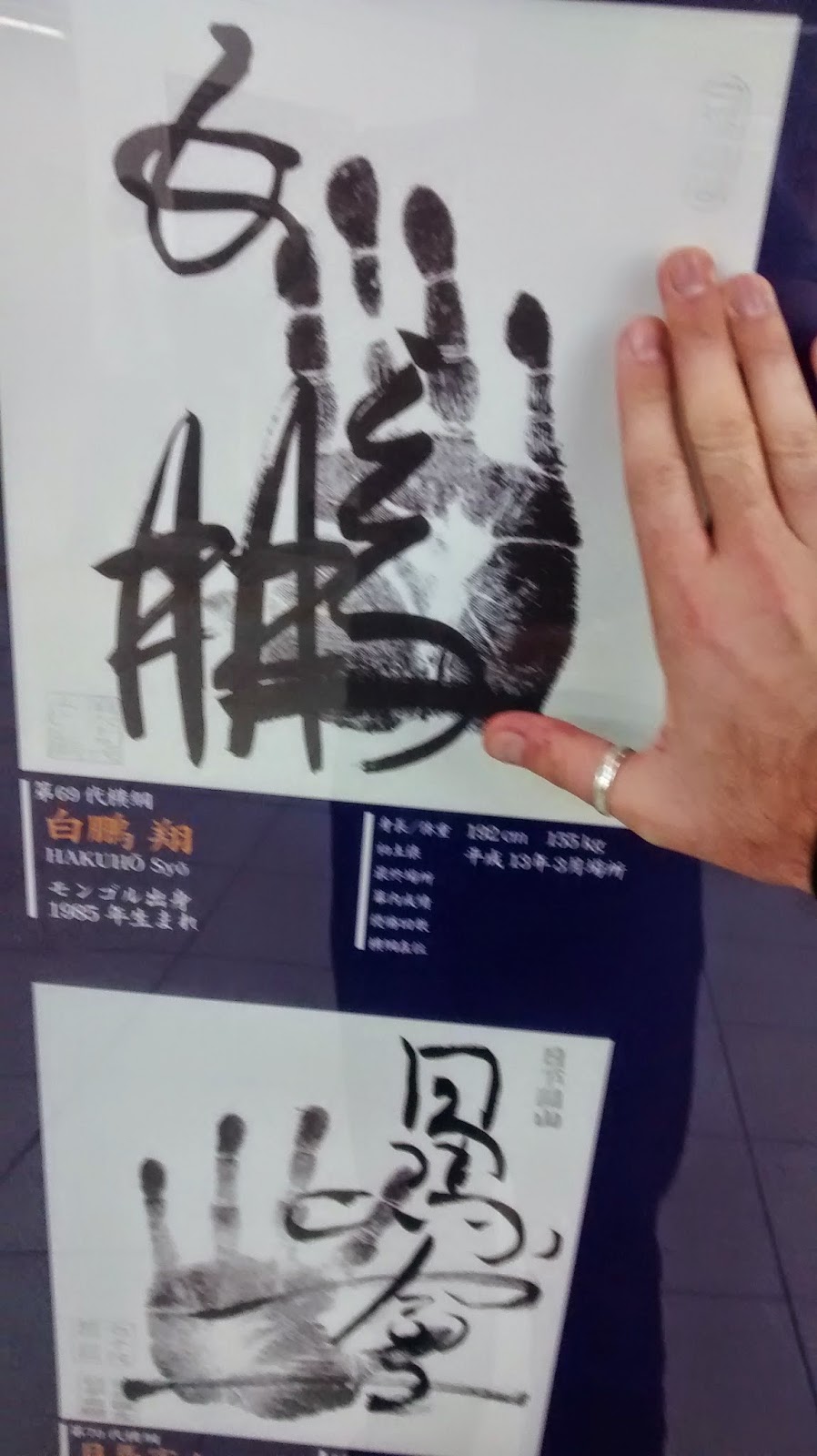
For many years the yokozuna has not been a Japanese person and it has been interesting to see the wrestlers from different countries. We saw two Yokozuna wrestle in the final match, Hakuho and Kakuryu both from Mongolia. Many come from central asian countries as well as Mongolia. A few from farther afield. One of the contenders at the match was an Egyptian.
The thing about sumo I really like is the anticipation and the shinto ritual proceeding the clash. The crowd is quiet, but occasionally gets riled up for a favorite contender. Two men, throwing salt and slapping bellies, plod around the ring until the moment both are completely ready and then BAM. Usually within a matter of 10 seconds the match is over and then its another 5-10 minutes before the next contenders clash.

All the while there are ads for sponsors, bouts for cash prizes, the girls with kegs on their backs shouting to sell you a beer and the Japanese people around you shuffling programs and eating squid. Its grand and I look forward to the next time as well. 

Monday, October 13, 2014

Beijing Property Market


Searching for an apartment in Beijing has been a royal pain. The first thing to note is that estate agents are not honest. Ok, you might say the same thing about realtors in the west since they may not disclose things about a property, they are essentially working for the home owner and for their own commission. This applies here in Beijing too, but the difference comes with the degree of deception. Many places that we have seen listed have looked very nice, but the actual apartments don’t resemble the pictures at all, or a listing will be posted one day and magically be sold by the time we contact the agency. No worries though, the agency has other property they can show us. When we have gone to properties sometimes the owners aren’t there so we went for no reason or the agents forget the key so we can’t get in. Its very unorganized. The other thing to note is that it seems property owners do not feel beholden to woo the customers. I still don’t understand why this is. Many places we saw were expensive, but were shown without being cleaned after the last tenants left or with trash lying around or peeling wallpaper. It would seem to me that selling property is an arms race, but maybe not. When we express interest but ask if small repairs can be made they say no. Its been a frustrating process but essentially this market seems to be experiencing very high demand for what may still be a limited thing in China. No, I don’t mean housing is limited, far from it. There are apartment buildings and villas springing up all around. Many places are less than half full and its getting to be that may apartment blocks outside the major cities are less than half filled. The thing that is in short supply is an investment vehicle for ordinary Chinese citizens.
Unlike in western countries ordinary Chinese citizens are not allowed to invest in foreign stocks, bonds, property or other things. Nor are they allowed to buy Chinese government bonds or to invest in Chinese companies that list on the stock market (the current IPO of Alibaba, the biggest IPO in history is made all the more interesting by that fact). So as a Chinese citizen where do you put your money to mature as you age? Housing. Forget about living in it, buy to invest. All this is fine to a degree, but it also means that the property market in China is red hot. The government has taken steps to slow this down like limiting couples to one mortgage between them (causing a lot of divorces in order to hold multiple properties) or putting a price cap on rents, which really just delays consumption not stop it. In some cities there have even been riots when housing prices have dropped since it means the next guy is getting a cheaper price than you did. If you are a real estate company you have to find other ways to promote your company over others.
All this comes back to finding a place to live here in Beijing. Trying to find an apartment where floor boards aren’t warped or the furniture stained in a building that isn’t decrepit and is close to some amenities has been a challenge. Most of the places that we have view are dirty, broken down, dark, badly decorated, or are so far from any supermarket/restaurant/transport to make them unlivable. Some of these places are downright embarassing. WHY would you put stickers of white people on your light switches?
Currently we are in a serviced apartment at Days Inn in Shunyi. It has two bedrooms and two bathrooms with a decent living room/dining area. It is serviced twice a week and there is a gym and pool on site. We also have the ear of the front desk and can ask for services if we need them. This runs us about 2000USD per month. As a living space its nice, but it takes at least 20 minutes to walk to the nearest restaurant/convenience store area. Not so convenient.
Just this week we finally settled for a place in Star City, Lido district. This puts us downtown, but not the center. The apartment is 3 bedrooms/2bath with a large enclosed balcony. Its too much space for us, but the best part was that the landlord had no furniture in the apartment and agreed to give us 2500USD with which to purchase furniture and appliances of our choosing. The rent is also about as good as it will get at about 1400USD a month. The property does have a small gym and the location puts us about a 5 minute walk from a few restaurants and a large grocery stores. Go 10-15 minutes on foot and the options increase. Also, we are right across the street from the 798 art district which should prove interesting for weekend exploration.
So we didn’t get an apartment with a bath tub in the living room or with a huge crystal chandelier. Besides finally landing our apartment what we did get was a glimpse into the property market of Beijing and man, it’s a mess. You just have to smile and laugh, remembering that, ‘Anything is Possible in China’.

Tuesday, September 23, 2014

Getting Around in Beijing


One of the first things that spring to mind when people think of China is the use of bicycles. When I first visited Beijing in 2004 (10 years ago!) I had stayed with my friend David whose mode of transport was mostly foot or bike. I distinctly remember sitting on his bike rack as he pedaled away on the busy streets of Beijing. As we emailed recently he had said that we, “experienced the last of the golden age” of the bicycle in China. Since the early 2000’s, or really you could argue since the mid 90’s the number of automobiles on the streets of China has been increasing by leaps and bounds. This year the government announced it will reduce the number of aging vehicles in China by about 6 million and about 350,000 in Beijing. While this represents a step towards better air quality the traffic will likely still be horrific as new cars hit the road.  Considering the amount of time spent in a car traveling or finding a parking space would be a welcome addition as it reduces traveling times and is good for the environment as less driving is being done.
While all this has been a boon to the Chinese economy and wonderful in many ways for the Chinese people there are also concerns of environmental pollution and not everyone can afford to purchase a car. Speaking with a Chinese friend the other day he told me that he had bought a car in Shanghai where he lived and the cost of getting the license plate for the carewas nearly the price of the car itself. Shanghai has opted to price out consumers and therefore to reduce congestion by limiting the use of cars to more wealthy citizens. Beijing has taken a different path. Instead of raising the price of the plates here the system is by lottery. From what I’ve been told its very hard to get one. I have had people tell me its about a 2% chance, and some people told me it takes 10 years or more to get one. In either case, its not easy. In order to get around the restrictions on plates and the steep prices for many people of purchasing a car there have been efforts to find alternatives.
The metro in Beijing is dirt cheap and the buses and subways are plentiful, but just like in the US people want to the freedom to have their own mode of transport. Many have come up with what I think is a brilliant solution. Electric trikes were my first exposure to this when we lived in Shanghai. Silent and fast many people used these to get around even during the winters and many of the streets in the newer areas of Shanghai were wide with specialized lanes for bike or scooter traffic. At many of the subway stations drivers with trikes would wait for those alighting to ask for a ride for a few blocks. In Beijing I was surprised to see that this has evolved into what I can only describe as miniature cars. There are many different types, but these are all electric relying on a battery to run. Most people either plug into central spots or they haul their battery up to their apartments to re-charge them. I’m fascinated with this option as the cars seat 3-4 people (small Asian people) have head lights, blinkers, windshield wipers, heaters, the works! I really want to buy one just for the novelty, but I can’t justify the expense. Even though these cars are designed to fill the gap for those who desire an auto but can’t afford them they still run 500-3000USD depending on the size and age. For now I will just have to fawn from afar and hope to get a ride from time to time.